Top 4 · #2 of 19 in Co-op
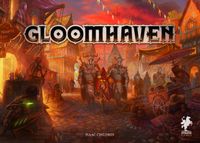
Gloomhaven
A tactical adventure RPG board game where you lead a band of mercenaries through dungeons in a changing world and grow stronger. As the campaign goes on, new scenarios and classes unlock and the story keeps going.
Rules
You play two ability cards each round and use the top half of one and the bottom half of the other. Your place in the turn order comes from the initiative number on a single leading card, and when your hand runs dry your character drops out of the scenario. In this dungeon crawler cards, not hit points, are the real resource.
Before you start — what this guide covers
Written spoiler-free
Gloomhaven is a campaign game. This guide covers only the rules you need to play your first session, and it deliberately says nothing about scenario content, unlockable classes, sealed envelopes, or event outcomes. Everything you need to open the box and run the first scenario is here.
One scenario is one play; scenarios strung together make a campaign. A scenario usually finishes in a single sitting, and what carries over to the next sitting is the town phase that follows it.
- There are no dice. Every attack draws one card from an attack modifier deck that raises or lowers the value.
- Your cards run out before your hit points do. If your hand empties, your character leaves the scenario even at full health — that is exhaustion.
- The turn order changes every round. Characters and monsters alike are ordered by the initiative number on the card they played this round.
- Nobody plays the monsters. One ability card is revealed per monster type, and fixed rules decide who they focus on and where they move.
- Six classes are available when you first open the box — Brute, Tinkerer, Spellweaver, Scoundrel, Cragheart and Mindthief.
Components
| Component | Count | Notes |
|---|---|---|
| Rule Book, Scenario Book, Town Records Book | 1 each | The Town Records Book starts sealed |
| Campaign map board | 1 | Tracks scenario locations, global achievements and prosperity with stickers |
| 2-sided map tiles / 2-sided overlay tiles | 30 / 155 | Assembled differently for every scenario |
| Character miniatures / monster standees / plastic stands | 18 / 240 / 24 | A white stand is a normal monster, a gold stand an elite |
| Character boards / monster statistic cards / stat sleeves | 17 / 47 / 6 | Damage and condition tokens are tracked on the sleeve |
| Character ability cards | 504 | One deck per class; more cards open up as you level |
| Monster ability cards | 232 | One deck per type; one card is revealed each round |
| Attack modifier cards | 457 | The standard 20-card deck plus class cards and curses/blesses |
| Item cards | 253 | Not class-specific. Bought and sold in town |
| Event cards | 150 | Road events and city events |
| Battle goal cards / personal quest cards | 24 / 24 | Battle goals give checkmarks; personal quests are retirement conditions |
| Random dungeon cards / random scenario cards | 40 / 9 | - |
| Player reference cards | 4 | - |
| Element infusion board / wooden element discs | 1 / 6 | Fire, Ice, Air, Earth, Light, Dark |
| Money tokens / damage tokens / status tokens | 50 / 46 / 60 | - |
| Summon tokens / objective tokens / scenario aid tokens | 32 / 12 / 10 | - |
| Character tokens / round tracker | 85 / 1 | Character tokens count the uses of persistent bonuses |
| Character pads / party pad | 17 / 1 | Where experience, gold, items and perks are written down |
| Sticker sheets / sealed envelopes / character tuck boxes | 4 / 3 / 35 | Envelopes are opened only when the game tells you to |
Scenario setup
- 1Lay out map tiles and overlay tiles as the Scenario Book shows. Only the starting room is populated at first.
- 2Place monsters according to the player-count markings — black means none, white a normal monster, gold an elite. Randomize the standee numbers as you place them.
- 3Read the introduction and apply any negative effects from the “Special Rules” section.
- 4Choose the scenario level. The recommended level is the party's average level ÷ 2, rounded up; you may shift it by −1 (Easy) up to +2 (Very Hard).
- 5Deal two battle goal cards to each player in secret; keep one and discard the other. Keep it hidden until the scenario ends.
- 6Decide which items to equip. If an item adds negative modifier cards, shuffle that many −1 cards into your attack modifier deck.
- 7Pick a hand from your available card pool equal to your hand size. At the start you only have Level 1 and “X” cards.
- 8Place your figure on any empty hex marked as a starting location.
- 9Apply the effects of any preceding road or city event now.
| Scenario level | Monster level | Gold per money token | Trap damage | Bonus experience on success |
|---|---|---|---|---|
| 0 | 0 | 2 | 2 | 4 |
| 1 | 1 | 2 | 3 | 6 |
| 2 | 2 | 3 | 4 | 8 |
| 3 | 3 | 3 | 5 | 10 |
| 4 | 4 | 4 | 6 | 12 |
| 5 | 5 | 4 | 7 | 14 |
| 6 | 6 | 5 | 8 | 16 |
| 7 | 7 | 6 | 9 | 18 |
If one person runs several characters, or you agree to show each other your hands, raise only the monster level and trap damage by 1. Gold conversion and bonus experience stay where they are — the penalty matches exactly the advantage of knowing everything.
The shape of a round
- 1Card selection — everyone secretly places two cards face down, or declares a long rest for the round.
- 2Determining initiative — reveal one ability card for each monster type on the map, then reveal your played cards with the leading card on top.
- 3Turns — everyone acts in order from the lowest initiative number upward.
- 4End of round — shuffle any deck that showed a shuffle symbol, wane the elements one step, clear round-bonus cards, and anyone who wants may take a short rest.
Talk about plans, never about numbers
“I'm attacking this guard around the middle of the round” and “I'll move up and heal you fairly early” are fine. “You need lower than initiative 17 to go before me”, “I'll do 4 damage to the bandit so don't worry” and “I'm playing this particular card” are not. All of the tension in this co-op comes from that restriction.
The core — two cards, one top action and one bottom action
Every ability card is split into a top and a bottom action and carries an initiative number. On your turn you perform the top action of one of the two cards you played and the bottom action of the other. You may do them in either order, but you must finish one completely before starting the other.
You may never use two top halves
It is always one top and one bottom. However good a single card is, you cannot take both of its halves in one turn. That one restriction creates the whole Gloomhaven puzzle: if you want that attack, where does your movement come from?
- Whatever is printed on it, any card can be played for a generic “Attack 2” on top or “Move 2” on the bottom. Used that way the card is always discarded.
- If the action you performed carries the lost symbol, the card goes to your lost pile instead of your discard. Lost cards only come back during a scenario through a specific recover ability.
- Actions with a persistent or round bonus are placed in the active area in front of you. When the last use is spent the card goes to the lost pile.
- Abilities on a card are resolved in the printed order and cannot be interrupted by the other card.
- You may skip parts of an action, except any part that would harm you or your allies — that part is mandatory.
- Items can be used at any point in your turn, but an item that affects an attack must be used before the modifier card is drawn.
| Tie | How it is resolved |
|---|---|
| Player vs monster | The player goes first |
| Player vs player | Compare the non-leading cards; the lower one goes first. If still tied, the players decide |
| Monster type vs monster type | The players decide the order |
| Monsters of the same type | All elites first, then the normal ones, each group in ascending standee number |
Lost cards, resting and exhaustion — cards are your real health
The only way to pull discarded cards back into your hand is to rest, and every rest loses one card permanently. Your number of turns in a scenario is therefore fixed from the start, and every round you are really asking whether this round is worth two cards.
| Short rest | Long rest | |
|---|---|---|
| When you declare it | The end of round step | The card selection step |
| Your actions that round | Completely normal | It is your whole turn. Initiative 99 |
| Which card is lost | Random | You choose |
| Re-draw | Suffer 1 damage to re-draw, once per rest | Not applicable |
| Extra effect | None | “Heal 2, Self” plus refresh all spent items |
| Requirement | Two or more cards in your discard | Two or more cards in your discard |
There are exactly two roads to exhaustion
①Dropping below one hit point. ②Starting a round unable to play two cards and unable to rest (one card or fewer in hand and one card or fewer in the discard). Either way that character leaves the map and cannot return for the rest of the scenario. If every character is exhausted, the scenario is lost.
Exhaustion is not death. If the others complete the scenario, an exhausted character still keeps all the experience and gold gathered up to that point and can still complete their battle goal. There is no penalty for being exhausted.
- Instead of taking damage you may lose one card from your hand or two from your discard to negate it entirely. Any conditions attached to the attack still apply.
- The two cards you placed down at the start of the round are in neither pile, so they cannot be used to negate damage.
- “Recover” returns discarded or lost ability cards to your hand; “refresh” restores spent or consumed items. A card marked cannot be recovered never comes back, however it was lost.
The hex map — movement, terrain and line of sight
- “Move X” means up to X hexes. You may move through allies but not through enemies or obstacles, and you cannot end in an occupied hex.
- A Jump ignores all figures and terrain effects on the way — but the last hex counts as normal movement, so a trap there still goes off.
- Flying ignores everything including the last hex; you still have to stop in an empty hex.
- Nothing moves through walls. Two hexes separated by a wall are not adjacent, and range is never counted through a wall.
| Overlay tile | Effect |
|---|---|
| Door | A character entering it flips it open and reveals the next room. A closed door is a wall to monsters and summons |
| Corridor | Behaves like an empty hex; it joins two map tiles into one room |
| Trap | Springs when entered and is then removed. A damage trap deals scenario level + 2 damage |
| Hazardous terrain | Deals half a trap's damage, rounded down, each time it is entered. The tile stays. Starting or ending a turn there costs nothing extra |
| Difficult terrain | Costs two movement points to enter. Jump, flying and forced movement ignore it |
| Obstacle | Blocks normal movement; jump and flying pass over it. It does not block ranged attacks |
| Treasure | Picked up with a Loot ability. A numbered tile can only ever be looted once |
Line of sight is corner to corner
You have line of sight if you can draw a line from any corner of your hex to any corner of the target's hex without touching a wall. Only walls block line of sight — obstacles and other figures do not. Every ability with a range needs line of sight; a non-attack ability with no range does not.
Attacking and the attack modifier deck
- 1The attacker's own modifiers first — bonuses from active cards, items and effects such as Poison.
- 2Then draw one attack modifier card and apply it. You draw one card per target.
- 3Finally subtract the defender's shield. Because this is done per target, one attack can deal different damage to each enemy it hits.
- “Null” makes the attack deal no damage; “×2” doubles it.
- A rolling modifier means you draw another card, and you keep drawing until a non-rolling card appears, then add everything together.
- Curse shuffles a curse card into the target's deck. When it is drawn it is removed from the deck entirely rather than discarded; Bless works the same way.
- There are separate curse decks for monsters and characters, ten cards each, so no single deck can hold more than ten curses.
- A monster brought to zero hit points dies immediately and the rest of the attack's effects are not applied. Unless it was summoned or spawned, a money token is placed where it died.
Shooting an adjacent enemy gives Disadvantage
Any attack that lists a Range suffers Disadvantage against a target in an adjacent hex. Conversely, an attack with no range printed is a melee attack — and if the hexes line up, a melee attack can even reach a non-adjacent target.
| Attack effect | What it does |
|---|---|
| Push X | Move the target X hexes, each hex further from the attacker. If there is nowhere to go, the push stops |
| Pull X | Move the target X hexes, each hex closer to the attacker. Pushes and pulls ignore difficult terrain |
| Pierce X | Ignores up to X of the target's Shield. Unlike other effects it is applied while the damage is being calculated |
| Add target | Adds one more enemy within range to the attack |
| Target X | Attacks X different enemies; a modifier card is drawn for each |
| Area attacks | Hit the hexes shown on the card. Any rotation is legal, and if the grey hex is included it counts as a melee attack |
Conditions and elements
| Condition | Effect | Removed when |
|---|---|---|
| Poison | Enemies add +1 Attack against this figure | A heal removes it (and does nothing else) |
| Wound | 1 damage at the start of each of its turns | A heal removes it and still heals normally |
| Immobilize | Cannot use move abilities | End of its next turn |
| Disarm | Cannot use attack abilities | End of its next turn |
| Stun | No abilities and no items at all (a character may still long rest) | End of its next turn |
| Muddle | Disadvantage on all its attacks | End of its next turn |
| Curse | A curse card is shuffled into its attack modifier deck | Removed from the deck when drawn |
| Invisible | Cannot be focused on or targeted by enemies | End of its next turn |
| Strengthen | Advantage on all its attacks | End of its next turn |
| Bless | A bless card is shuffled into its attack modifier deck | Removed from the deck when drawn |
Only one of each condition can sit on a figure at a time, but reapplying it refreshes the duration. Conditions land whether or not the attack that carried them actually dealt damage.
There are six elements — Fire, Ice, Air, Earth, Light and Dark — and three columns on the element board: Strong, Waning and Inert. A plain element symbol in an action means that performing it infuses that element to “Strong” at the end of the turn. A symbol crossed with a red slash means you may consume an element sitting in Strong or Waning, moving it to Inert, to get the augmented effect printed after the colon.
You cannot consume what you just created
Elements only rise at the end of the turn, so you can never create and consume one on the same turn. An ally acting later in the same round can. Monsters always consume an element if they are able to, and a single symbol can never consume more than one infusion.
The rules play the monsters
- One ability card is revealed per monster type on the map, and every monster of that type follows it.
- They perform the listed abilities in the printed order and do nothing that is not listed — no movement or attack unless the card says so.
- Hit points, move, attack and range come from the side of the statistic card matching the scenario level; elites use the elite half.
- Order of action is all elites first, then all normals, each in ascending standee number.
- If the card shows a shuffle symbol, that type's ability deck is shuffled at the end of the round.
- 1Before acting, each individual monster picks one enemy to focus on.
- 2The measure is “how few hexes must I move to use the attack on my card”, and the figure reachable in the fewest steps is the focus — it does not matter whether it can actually get there this turn.
- 3If two are tied, compare actual proximity in hexes, then initiative order. A character taking a long rest is focused on last.
- 4Having chosen a focus, the monster moves the fewest hexes that let it attack with maximum effect. A move without an attack simply closes to the nearest hex adjacent to the focus.
- Ranged monsters back away to avoid Disadvantage. Staying in range while losing adjacency takes priority over hitting extra targets.
- A monster without Flying treats traps and hazardous terrain as obstacles when working out focus and movement; it only crosses them when there is no other path, and then takes the path through the fewest bad hexes.
- Monster healing goes to whichever of its own side has lost the most hit points.
- Monsters summoned by monsters never act on the round they appear and drop no money token when killed.
- Bosses have their own statistic cards but act from a shared Boss ability deck. They are neither normal nor elite, and a “C” in their stats means “per character”.
When the rules do not decide, the players do. If several hexes or several equally valid targets qualify, the group chooses which option the monster takes.
Ending a scenario and cashing out
- Success means meeting the goal on the scenario page. Failure means every character is exhausted.
- Once either condition triggers, the rest of the round is played out and then the scenario ends.
- Win or lose you keep the experience earned and the money tokens you picked up; tokens convert to gold by scenario level. Anything not looted is gone.
- On a success you also gain bonus experience of 4 + twice the scenario level and the checkmarks from any completed battle goal. Every three checkmarks grants an extra perk.
- A success lets you read the conclusion text and take the listed rewards — achievements, gold, experience, prosperity, unlocks.
- Afterwards recover all lost and discarded cards, refresh spent and consumed items, and reset hit points to maximum. Strip out any curses, blesses and temporary cards added to the modifier decks.
Killing monsters earns no experience
You gain experience only from actually performing an action that prints an experience value. Clearing the whole map earns nothing by itself, which is why playing your cards efficiently is the same thing as levelling quickly.
The campaign and the town phase
After a scenario you either return to Gloomhaven or travel straight on to the next one. Travelling on means resolving one road event — unless you are replaying the same scenario or the two are listed as linked.
- In campaign mode you may only play scenarios whose required global and party achievements are active, and a scenario completed in campaign mode is never played that way again.
- In casual mode any revealed scenario is available, but story text and rewards are ignored. Experience, gold, battle goals and personal quests still count.
- Reputation belongs to the party and runs from −20 to +20. High reputation makes items cheaper, low reputation makes them dearer.
- Prosperity belongs to the town and applies to every party. Raising it opens new items in the shop and lets new characters start at up to the prosperity level.
| Town activity | What it does |
|---|---|
| City event | One per visit. Outcomes are generally kinder than road events |
| Create a new character | Keep one of two personal quests. Starting gold is 15 × (level + 1) |
| Buy and sell items | Selling returns half the printed price, rounded down. No duplicates of an item |
| Level up | Only in town. One new card, one perk, and a higher maximum hit point total |
| Donate | 10 gold per player per visit; adds two Bless cards to your deck for the next scenario |
| Enhance ability cards | Available after the matching global achievement. Stickers are permanent, and enhanced cards are capped at the prosperity level |
| Announce retirement | A character whose personal quest is fulfilled must retire |
| Level | 1 | 2 | 3 | 4 | 5 | 6 | 7 | 8 | 9 |
|---|---|---|---|---|---|---|---|---|---|
| Experience needed | 0 | 45 | 95 | 150 | 210 | 275 | 345 | 420 | 500 |
- Levelling adds one card of your class at or below your new level to your pool. Your hand size does not grow, so each scenario becomes a question of what to leave behind.
- A perk is surgery on your attack modifier deck — remove a bad card, or add one carrying an effect. Every three checkmarks yields one more perk on top.
- You may equip one Head, one Body, one Legs, two One-Hand items or one Two-Hands item, and small items up to half your level, rounded up.
- Retiring returns the character's gear to the box and the shop and raises the town's prosperity by 1. From then on every new character that player makes starts with one extra perk, and this stacks with each retirement.
Retirement is not a loss; it is how the campaign moves forward. Fulfilling a personal quest opens up new content, and your next character starts at a higher level with more perks.
Strategy that follows straight from the rules
- Count your remaining turns first. With N cards in hand, each rest costs you one. Knowing roughly how many rounds you have left makes “is this the moment to burn a lost card?” an easy question.
- The leading card is about *when*, not *what*. Once you know which attack you want, pick the leading card that puts you before or after the monsters as needed.
- Movement mostly lives on the bottom halves and attacks on the top halves, so playing two great attacks means standing still.
- Ranged classes should avoid adjacency — shooting the hex next to you is automatic Disadvantage.
- Because monsters follow fixed rules, they can be baited. Treating traps as obstacles, and focusing on whoever is cheapest to reach, are both tools you can use.
- Elements are a shared, one-round resource. Line up roughly who creates and who consumes before the round starts — without naming numbers.
- Battle goals usually ask you to fight in a particular way. They are not worth losing the scenario over — on a failure you get nothing from them at all.
Editions and expansions
| Product | What it is |
|---|---|
| Gloomhaven: Forgotten Circles | A small expansion assuming you have finished the base campaign: 20 scenarios and a new class |
| Gloomhaven: Jaws of the Lion | A standalone introduction that needs no base game, teaches the rules gradually and is far smaller |
| Frosthaven | The sequel, using the same system in its own box |
| Gloomhaven: Buttons & Bugs | A small solo version. ⚠️ Unverified — we could not confirm whether it has a Korean release |
| Gloomhaven (Second Edition) | A different product, released in 2025 with reworked scenarios, classes and rules. This guide describes the original, not the second edition |
- Reduced randomness: treat “×2” and Bless as +2 and “Null” and Curse as −2. You still shuffle as normal.
- Permanent death: dropping below one hit point kills the character outright. A character exhausted by running out of cards keeps their figure on the map, where it can still be attacked.
- Open information and solo play: show your hands, but raise monster level and trap damage by 1.
- A separate removable sticker set is sold for the base game, so a finished campaign can be reset.
Rules people get wrong
Q. Can I use the top halves of both cards I played?
No. It is always one top half and one bottom half. You choose which card supplies which and in what order. You may, however, play any card for a generic “Attack 2” on top or “Move 2” on the bottom — and such a card is always discarded.
Q. Is my initiative the sum of the two cards?
No. It comes from the single card you placed on top as your leading card. The other card's number is only used to break ties between players.
Q. If I declare a long rest, do I do nothing else that round?
Correct — the rest is your entire turn. At initiative 99 you choose one discarded card to lose, return the rest to your hand, perform “Heal 2, Self” and refresh every spent item.
Q. Does a character die at zero hit points?
Under the standard rules they become exhausted: out of this scenario only, not gone from the campaign, and they still keep everything they collected if the others succeed. Death only happens with the optional Permanent Death variant.
Q. Do I get experience for killing lots of monsters?
No. Experience comes only from performing actions that print an experience value, plus the success bonus of 4 + twice the scenario level.
Q. Does an attack on several enemies draw one modifier card or many?
One per target. Shields are applied per target too, so the same attack can end up dealing different damage to each enemy.
Q. Can I consume an element I created this turn?
No. Elements only reach “Strong” at the end of the turn. An ally acting later in the same round can consume it, and at the end of the round it wanes a step.
Q. Do obstacles block line of sight?
They do not. Only walls block line of sight; obstacles merely block normal movement and ranged attacks pass right over them. Two hexes separated by a wall, though, are not even adjacent.
History and background
- Designed by Isaac Childres and published by Cephalofair Games in 2017.
- The 2015 Kickstarter raised about $386,000 from 4,904 backers; the 2017 reprint campaign drew over 40,000 backers and roughly $4 million.
- It took a sweep of 2017 Golden Geek awards including Board Game of the Year, and in 2018 the Origins Award for Game of the Year and the SXSW Tabletop Game of the Year.
- It held the number one overall spot on BoardGameGeek from 2017 until February 2023.
- The box holds 95 scenarios and 17 classes, six of which are available from the start.
- The Korean edition is published by Korea Boardgames, which has also released Forgotten Circles, Jaws of the Lion and Frosthaven in Korean.
- Digital versions exist for Windows (2019) and macOS (2021).
When a ruling is unclear, check the publisher's official FAQ first. If you own the Korean edition, also read the errata published by Korea Boardgames — the numbers on several ability cards really did change (note that the errata itself contains scenario spoilers).
Sources
Official Cephalofair Games rulebook (Gloomhaven, English, 20 pages) — 1j1ju mirror; verified by content to be the first-edition rulebook that points readers to cephalofair.comKorea Boardgames errata for the Korean edition — errors that affect play (the document itself contains scenario spoilers)Korea Boardgames replacement card sheet for the Korean edition (the document itself contains scenario spoilers)Cross-checked against Wikipedia: GloomhavenCross-checked against Namuwiki: Gloomhaven (Korean)Rule summaries are reference content written by us, not quotations from the official rulebook. Always check the official rulebook for exact rules. Diagrams are original schematics, not rulebook illustrations.
Spotted a mistake? Tell us in the comments below →
Last updated 2026-09-14
💡 Master tip
You need practice using the top and bottom halves of your move and attack cards flexibly. Count when your hand will run out and choose the moment to rest carefully.
Similar games
Ready for something heavier
If this one has gotten too easy, try these — same feel, one step up in weight.
Tools you can request
Not built yet. Let us know if you want one — it goes on the list.
Counts include public tool requests only, excluding repeats from the same browser. These are not signed-in people counts: other devices or cleared cookies can be counted again.
Monster AI and health tracker
Live tracking of monster damage, conditions, and initiative numbers.
Element tracker
Shows all six elements — fire, ice, air, earth, light, dark — being created and consumed.
Comments
Share your thoughts, report a mistake, or request a tool. No sign-in needed — nicknames are not verified, so anyone can use the same one.
Loading…