Top 101 · #19 of 60 in Family
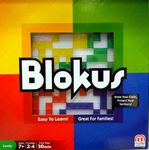
Blokus
A Mensa Select abstract strategy game where you place 21 Tetris-shaped polyomino pieces (1 to 5 squares) so that each new piece touches your own pieces only at the corners, trying to fit as many of your blocks onto the board as possible. The rule is a single principle — corners only, no edge contact — so it is easy to learn, but the spatial reasoning needed to block your opponents' expansion while widening your own space runs very deep.
Rules
Each player tries to fit as many of their own pieces as possible onto a shared 20×20 grid. There is really only one rule — a new piece of your colour must touch an existing piece of your colour only at a corner, never along an edge. Edges against other colours are unrestricted, which turns the whole game into a fight for corners and blocking space.
Components — 84 pieces
| Component | Count | Notes |
|---|---|---|
| Board | 1 | A 20×20 (400-square) grid |
| Pieces | 84 | 21 pieces each in blue, yellow, red, and green |
| 1-square piece (monomino) | 1 per colour | The smallest piece |
| 2-square piece (domino) | 1 per colour | |
| 3-square pieces (trominoes) | 2 per colour | |
| 4-square pieces (tetrominoes) | 5 per colour | |
| 5-square pieces (pentominoes) | 12 per colour | The largest size and the most numerous |
The pieces look like Tetris blocks, but the set actually covers every polyomino shape from 1 to 5 squares. All 21 pieces of a colour are different shapes.
Setup
- 1Place the 20×20 board in the middle of the table.
- 2Each player chooses a colour and places that colour's 21 pieces in front of them.
- 3Play order is blue, then yellow, then red, then green.
- 4Each player's first piece must cover one of the board's four corner squares.
Turn structure
- 1On your turn, place one piece from your hand onto the board following the rules.
- 2A placed piece may never be moved or flipped on a later turn.
- 3If you have no piece that can legally be placed, your turn is simply skipped and play moves on.
- 4Turns keep cycling blue, yellow, red, green in that order.
Rotating or mirroring a piece is always allowed. Changing its orientation before playing it is not a rule violation — but once it is on the board, it cannot be moved.
The core rule — corners only, never edges
The one rule this whole game is built on
A newly placed piece must touch an already-placed piece of your own colour at a corner, at least once. Pieces of the same colour may never share an edge. Pieces of different colours may touch however they like, edge or corner, with no restriction.
- Even if a new piece covers several squares, just one of those squares needs to touch your own existing piece at a corner.
- Conversely, if any square of the new piece shares an edge with your own existing piece, the whole placement is illegal.
- Placing a piece edge-to-edge against an opponent's colour to block their expansion is a legitimate tactic.
Scoring
| Situation | Score |
|---|---|
| Each square in your unplayed pieces | −1 |
| All 21 pieces placed on the board | +15 |
| All placed, and the last piece played was the 1-square piece | +15 + 5 bonus = +20 |
The +15 bonus only applies if every piece is placed, and the extra +5 only applies if, on top of that, your own last piece played was the single square. Falling short of either simply means your score is the negative square count.
End of the game and winning
- 1The game ends once every player is unable to place any more pieces.
- 2A player who has already placed all 21 pieces does not end the game by themselves if others can still play.
- 3Each player counts the unplaced squares remaining in hand and subtracts them, adding any bonus they earned.
- 4The highest final score wins.
Strategy — straight from the official rule sheet
- Early on, move toward the center of the board rather than staying near your starting corner, to claim as much space as possible.
- Try to place your larger pieces (4 and 5 squares) early. Saved for later, there may be no room left for them.
- Keep track of the corners of your own pieces so you always have options for your next move.
- Keep an escape route (a corner you can still extend from) open on each side of your colour's area.
- Block an opponent's most advanced corners to slow them down — but it is often more effective to wait and let them expose themselves first.
- Hold back squares that no other player can use, and the matching pieces, for later rather than using them right away.
- Consider not just your own remaining pieces but your opponents' remaining pieces too — an empty area is useless to them if they lack the right shape.
- Placing all 21 pieces is worth up to +20 points. Sometimes it pays to block an opponent from emptying their hand even if it costs you a few placements of your own.
Player-count variants and solo puzzles
| Players | How it works |
|---|---|
| 4 (standard) | Each takes one colour. Order: blue, yellow, red, green |
| 2 | One player controls blue+red, the other yellow+green; each totals their own two colours |
| 3 | Each chooses one colour; the leftover colour is played alternately by all three, but its score is ignored |
| 2-vs-2 teams (4 players) | One team plays blue+red, the other yellow+green; team scores are summed and compared |
| Solo puzzles | Fit all 84 pieces onto the 20×20 board under the normal rules, or pack the 20 four-square pieces into an 8×10 rectangle, or the 48 five-square pieces into a 15×16 rectangle (for extra difficulty, also forbid same-colour edge contact) |
The triangular Blokus Trigon is a different product
Blokus Trigon uses triangular cells instead of squares and is a separate release, so even its grid geometry differs from the square 20×20 base game covered here. Blokus Duo, Junior, and 3D are likewise separate products with different boards and components.
Frequently confused rules
Q. Does the game end the moment one player has no legal move?
No. A player with no legal move just has that turn skipped, and the others keep playing. The game ends only once every player is simultaneously unable to place anything.
Q. Can pieces of different colours touch along an edge?
Yes. The corners-only rule applies only between pieces of the same colour. Different colours may touch edge-to-edge or corner-to-corner with no restriction.
Q. Who plays the fourth colour in a 3-player game?
All three players take turns playing that colour's pieces. When the game ends, however, that colour's score is not counted.
Q. Are the rules actually different in a 2-player game?
The turn order (blue, yellow, red, green) and the adjacency rule stay the same. One player simply controls two colours (blue+red or yellow+green) and totals the scores of both.
Q. What is the difference between +15 and +20 points?
Placing all 21 pieces alone earns +15. If, in addition, your own last piece played was the single-square piece, 5 more points are added for +20.
Q. Can a piece be moved to a better spot after it's placed?
No. Once a piece is on the board it cannot be moved on a later turn. Rotating or flipping it is only allowed before it is placed.
History and editions
Based on a concept by the French designer Bernard Tavitian, the game was first published in 2000 by the French company Sekkoïa, with Mattel taking over production and distribution from 2008. It won a Mensa Select award in 2003, along with several regional awards including a Japan Boardgame Prize and an Australian Game of the Year.
In Korea, Korea Boardgames officially distributes the square-grid base edition covered by this guide. Separate spin-offs with different boards or components exist, including the triangular-grid Blokus Trigon, the two-player 14×14 Blokus Duo, and the three-dimensional Blokus 3D (originally Rumis) — none of them share this guide's rules.
Sources
Official Mattel English rule sheet (Blokus, R1983-0825)BoardGameGeek: Blokus (2453)Wiki cross-check — English Wikipedia: BlokusWiki cross-check — Namuwiki: Blokus (Korean)Rule summaries are reference content written by us, not quotations from the official rulebook. Always check the official rulebook for exact rules. Diagrams are original schematics, not rulebook illustrations.
Spotted a mistake? Tell us in the comments below →
Last updated 2026-10-10
💡 Master tip
Early on, save your small pieces and push your large 5-square pieces toward the center first to stake out a long stretch of territory. From the midgame onward, keep your own expansion routes open while also placing pieces against your opponents' pieces to narrow their space.
Similar games
Ready for something heavier
If this one has gotten too easy, try these — same feel, one step up in weight.
Tools you can request
Not built yet. Let us know if you want one — it goes on the list.
Remaining-block penalty calculator
Calculates the squares left in hand and the all-clear bonus
First-move corner locator
Guide to the starting corner positions
Comments
Share your thoughts, report a mistake, or request a tool. No sign-in needed — nicknames are not verified, so anyone can use the same one.
Loading…