Top 1 · #1 of 40 in Strategy
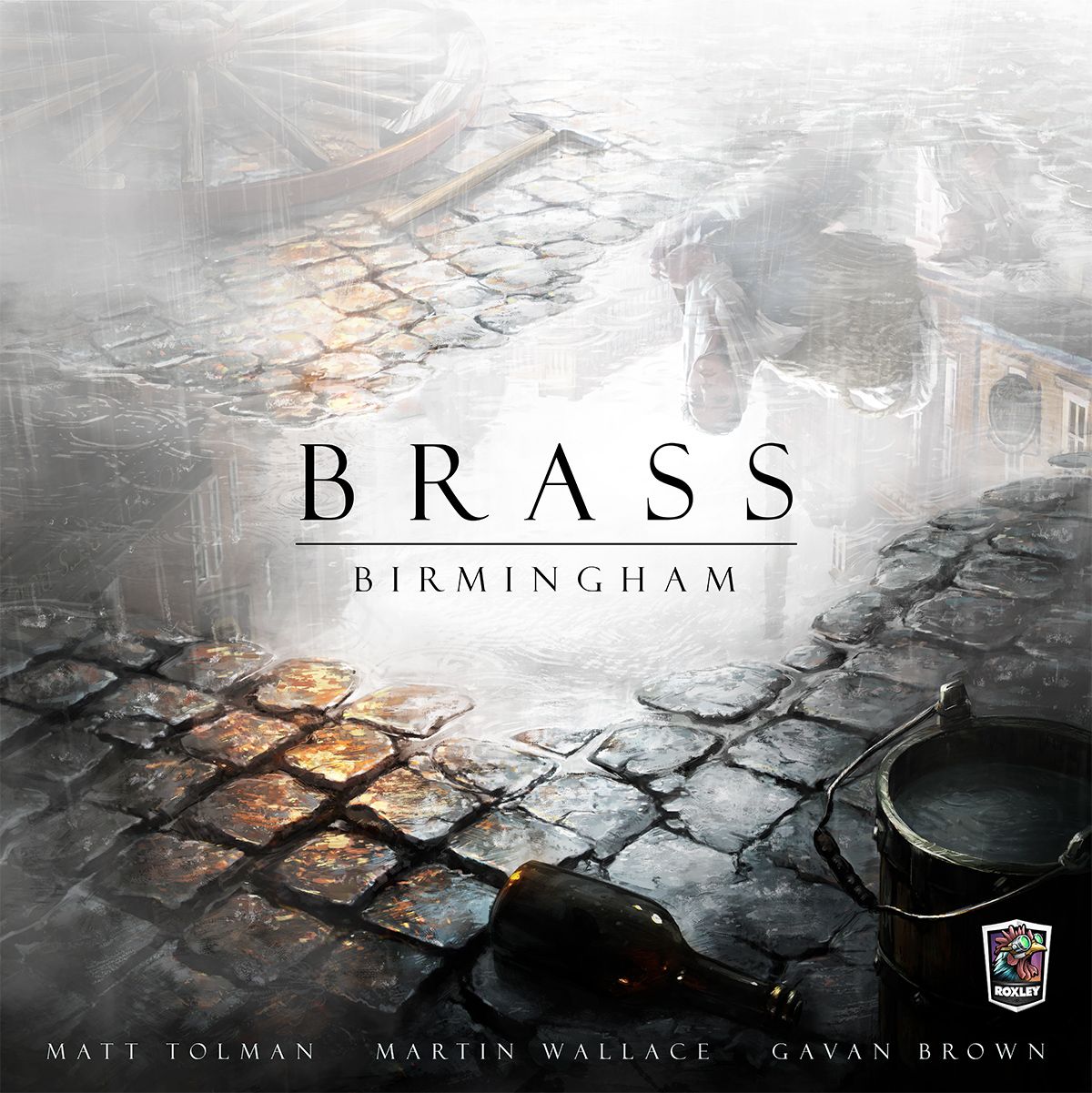
Brass: Birmingham
A heavyweight economic strategy game set around Birmingham during the Industrial Revolution, where you build industries, link them by canal and rail, and trade resources to expand your reach. Play runs through two eras, and the heart of the game is flipping your industry tiles to score. Fans of heavy euros routinely name it the best of the genre.
Rules
An economic game set in the West Midlands between 1770 and 1870, where you build industries and link them by canal and rail. The heart of it is flipping tiles: a tile you have merely built earns you nothing until you sell it, or until its last resource is taken away.
A game of exactly two eras
The game runs through the Canal Era (1770-1830) and the Rail Era (1830-1870). Each era continues until the Draw Deck and every player's Hand are exhausted, and at the end of each era you score your Link tiles and your flipped Industry tiles. Whoever has the most Victory Points after the Rail Era wins.
| Players | Rounds per era | Location cards left out |
|---|---|---|
| 2 | 10 rounds | Blue and teal Location cards |
| 3 | 9 rounds | Teal Location cards |
| 4 | 8 rounds | None — all are used |
You may still build in locations whose cards were removed
The player count removes cards, not locations. If the location is part of your network you can build there with an Industry card as usual. Every location on the board is in play even at 2 and 3 players.
There is a single Progress Track, and your Income Marker travels along the same track as your VP Marker. If you pass 100 VPs, start another loop of the track.
Components
| Component | Count | Notes |
|---|---|---|
| Board | 1 | Use either the day side or the night side |
| Location and Industry cards | 64 | The player count is printed in the bottom right corner |
| Wild cards | 8 | 4 Wild Location + 4 Wild Industry |
| Merchant tiles | 9 | Only the Merchant spaces matching your player count get one |
| Link tiles | 56 | 14 per colour — the same tile serves as canal and rail |
| Industry tiles | 180 | 45 per colour (see the table below) |
| Player Mats, Character tiles, Player Aids | 4 each | Industry tiles are stacked on the mat by level |
| VP Markers and Income Markers | 4 each | Both move along the Progress Track |
| Coal cubes / Iron cubes / Beer barrels | 30 / 18 / 15 | Substitute anything if you run out — the General Supply is limitless |
| Money tokens | 77 | The Deluxe Edition replaces these with 78 Iron Clays |
| Industry (per colour) | Count | How it flips |
|---|---|---|
| Cotton Mill | 11 | Sell action |
| Manufacturer | 11 | Sell action |
| Pottery | 5 | Sell action |
| Coal Mine | 7 | When the last coal leaves the tile |
| Brewery | 7 | When the last beer leaves the tile |
| Iron Works | 4 | When the last iron leaves the tile |
The faces look inverted at first. The side with the black top half is the flipped, scoring side of an Industry tile, so during setup that side goes face down.
Setup
- 1Lay out the board on the day or night side. For fewer than 4 players, return every card and Merchant tile showing a higher player count to the box.
- 2Put the Wild Location and Wild Industry cards face up on 2 of the Card Draw Areas, then shuffle the rest and place them face down on the remaining one (the Draw Deck).
- 3Shuffle the remaining Merchant tiles and place 1 face up on each Merchant space marked with your player count. At 2 players there is no Merchant in Warrington or Nottingham; at 3 players, none in Nottingham.
- 4Place 1 beer barrel on the space beside each non-blank Merchant tile.
- 5Fill the Coal Market with 1 black cube per space, leaving 1 of the £1 spaces open, and the Iron Market with 1 orange cube per space, leaving both £1 spaces open.
- 6The remaining cubes and barrels form the General Supply; the money forms the Bank.
- 7Each player takes a Player Mat, a Character tile, the matching Link tiles, and £17. Stack your Industry tiles on their slots with the black top half face down.
- 8Put your VP Marker on «0» and your Income Marker on «10» on the Progress Track.
- 9Draw 8 cards as your Hand, then draw 1 more and place it face down in your player area as your Discard Pile.
- 10Once everyone is set up, shuffle the Character tiles and place them in random order on the Turn Order Track.
Only from the top of the stack
When you build, the only tile you may take is the lowest level tile of that industry. To reach a better one you must either build the tiles in front of it or clear them with the Develop action.
Your turn and the six actions
- 1On your turn you take 2 actions in total, and you may take the same action twice. The exception is the first round of the Canal Era, which is 1 action.
- 2Discard 1 card from your Hand for each action, passing included, face up onto your Discard Pile.
- 3When you spend money, put it on your Character tile on the Turn Order Track rather than into the Bank — what you spent this round decides next round's turn order.
- 4After your actions, refill your Hand back up to 8 cards. Once the Draw Deck is exhausted your Hand shrinks each round, and the era ends when everyone has played their last card.
| Action | What it does | Card required |
|---|---|---|
| Build | Place an Industry tile from your mat onto the board (pay the cost, consume coal / iron) | A specific card — the location or the industry has to match |
| Network | Place Link tiles (canal or rail) on undeveloped lines | Any 1 card |
| Develop | Remove 1 or 2 Industry tiles from your Player Mat (consume iron) | Any 1 card |
| Sell | Sell Cotton Mills, Manufacturers and Potteries to a Merchant to flip them (consume beer) | Any 1 card |
| Loan | Take £30 and move 3 income levels backwards | Any 1 card |
| Scout | Discard 3 cards and take 1 Wild Location and 1 Wild Industry card | Any 3 cards |
| Pass | Do nothing | Any 1 card |
Wild cards never reach your Discard Pile
A discarded Wild card goes back onto its Card Draw Area. That is why the Wilds are always waiting there after the deck is reshuffled, and why you may not Scout while you already hold a Wild card.
- 1End of round ① — whoever spent the least money goes first next round and whoever spent the most goes last. Players who spent the same amount keep their relative order. Then all the money on the Character tiles goes back to the Bank.
- 2End of round ② — take money from the Bank equal to your income level. No income is collected at the end of the final round of the game.
If your income is negative and you cannot pay
Remove Industry tiles (never Link tiles) from the board to raise money. Each is worth half its build cost, rounded down, and you must stop as soon as you can cover the shortfall. If you still cannot pay, lose 1 VP for every £1 you are short.
The Build action — the card decides where and what
Of the six actions, only Build cares which card you discard. Everything else takes any card from your Hand; Build takes a card that names the place or the industry.
- 1Discard an appropriate card.
- 2Take the lowest level tile of that industry from your mat and place it black-top-half face down on an undeveloped space in the location. Prefer a space showing only that industry's icon; otherwise use a space that shows it alongside another industry. If neither exists, you cannot build there.
- 3Pay the cost printed to the left of its slot onto your Character tile and consume the iron and coal shown. If coal is required, the location has to be connected to a source of coal.
- 4If you built a Coal Mine or Iron Works, place the number of cubes shown in the bottom right corner onto the tile. A Brewery gets 1 beer barrel in the Canal Era and 2 in the Rail Era.
Selling to the Market the moment you build
A Coal Mine connected to any Merchant space (even one with no Merchant tile on it) and an Iron Works, connected or not, immediately move as many cubes as possible from the tile into their Market, filling the most expensive spaces first, and you collect the money shown. If the last cube leaves the tile, it flips right there. This only happens during the action that builds the tile — cubes are never sold to the Market on later turns.
| Era | Your Industry tiles per location |
|---|---|
| Canal Era | At most 1 (each opponent may also have one there) |
| Rail Era | Several are allowed |
- Overbuilding — you may replace an already placed Industry tile with a higher level tile of the same type, still paying the full build cost.
- Your own tile may be overbuilt with no restriction, and any cubes on it return to the General Supply.
- An opponent's tile may be overbuilt only if it is a Coal Mine or an Iron Works, and only when no cube of that type is left anywhere on the board, the Market included.
- Overbuilt tiles leave the game and score nothing, but the income and VPs they already earned are not taken back.
- If you have no tiles on the board at all, you may build the matching industry in any location with an Industry card, or place a Link tile on any undeveloped line with any card (still consuming coal for a rail Link).
Networks — «yours» and «connected» are different things
| Concept | Definition |
|---|---|
| Your network | Locations containing your Industry tiles, plus every location adjacent to your Link tiles |
| Connected locations | Two locations you can trace a route between along Link tiles owned by anyone |
«Your network» decides where you may build; «connected» decides where you may draw resources from. Other players' Link tiles count for the second, never for the first.
| Network action | Canal Era | Rail Era |
|---|---|---|
| What you may place | Canals only (undeveloped canal lines) | Rails only (undeveloped railroad lines) |
| One Link | £3 | £5 + 1 coal |
| Two Links | Not possible — 1 per action | £15 + 1 coal each + 1 beer |
- A Link tile must go on an undeveloped line adjacent to your network. If you have nothing on the board, any undeveloped line will do.
- The beer for a double rail Link must come from a Brewery — Merchant beer cannot be used.
- If that beer comes from an opponent's Brewery, the Brewery must be connected to the second rail Link after it is placed.
- Each rail Link is placed separately and each must be connected to a source of coal after it is placed.
- Taking the Network action twice in one turn lets you place up to 4 rail Links.
A Farm Brewery may only be built with a Brewery Industry card or a Wild Industry card. It has no name, so a Wild Location card does not work there.
Resources — coal, iron and beer follow different rules
| Resource | Connection needed? | Where it comes from |
|---|---|---|
| Coal | Yes | The closest connected Coal Mine → otherwise the Coal Market (needs a connection to a Merchant icon; £8 each if empty) |
| Iron | No | Any unflipped Iron Works → otherwise the Iron Market (£6 each if empty) |
| Beer | Not for your own Brewery | Your Brewery → a connected opponent's Brewery → the barrel beside the Merchant you are selling to |
- If several Coal Mines are equally close, choose one. If one runs out and you need more, move on to the next closest.
- Iron does not have to be the closest. If you need 2, you may take 1 from each of two different Iron Works.
- Any unflipped Coal Mine or Iron Works is free to use whoever owns it. The owner is not paid.
- When several beers are required, each may come from a different source.
- Consumed cubes and barrels go to the General Supply, not back to their owner.
- Buying from a Market always starts at the cheapest space. Even an empty Market sells coal at £8 and iron at £6.
Using someone's resource is doing them a favour
Taking the last coal from an opponent's Coal Mine flips that tile and raises their income. So «where do I draw this from» is both a question of cost and a question of how much you want to help them.
Flipping tiles and income
A tile that has merely been built pays neither income nor VPs. Only once it flips does the number in its bottom right corner raise your income, and only then does the VP value in its bottom left corner count at the end of an era.
«Spaces» and «income levels» are not the same
Flipping a tile advances your Income Marker a number of spaces; a Loan moves it back a number of income levels. One income level covers several spaces, which is why the two never match. Your income level cannot go above 30.
- A Loan gives you £30 and is never repaid. The 3-level drop is the whole price.
- You cannot take a Loan that would push your income level below -10.
- A negative income level means you pay that amount to the Bank at the end of the round.
The Sell action and Merchant beer bonuses
- 1Discard any card from your Hand.
- 2Choose one of your unflipped Cotton Mill, Manufacturer or Pottery tiles. It must be connected to a Merchant tile showing that industry's icon.
- 3Consume the beer shown in the tile's top right corner. If a beer barrel sits beside the Merchant you are selling to, you may use it and collect the Merchant beer bonus.
- 4Flip the tile and advance your Income Marker by the number in its bottom right corner.
- 5Go back to step 2 and keep selling your other unflipped tiles, including ones from a different industry, in the same action.
If you cannot consume all the beer required, you cannot sell that tile. There is no partial sale and no paying later.
| Merchant beer bonus | Location | Effect |
|---|---|---|
| Develop | Gloucester | Remove 1 lowest level tile of any industry from your mat, for no iron cost |
| Income | Oxford | Advance your Income Marker 2 spaces along the Progress Track |
| Victory Points | Nottingham · Shrewsbury | Advance your VP Marker by the number of spaces indicated |
| Money | Warrington | Receive £5 from the Bank |
- Merchant beer may only be consumed as part of a Sell action — never for a double rail Link.
- Even the Develop bonus cannot remove a Pottery tile showing the lightbulb icon.
- The barrels beside the Merchant tiles are replaced at the end of the Canal Era.
The Develop action — clearing tiles with iron
Discard a card and return 1 or 2 Industry tiles from your Player Mat to the box. Each must be the lowest level tile of its industry as it is removed, and each costs 1 iron. The two may come from different industries. A Pottery showing the lightbulb icon cannot be developed and has to be built away instead.
End of an era and scoring
- 1Score Links — for each of your Link tiles, score 1 VP for every VP icon shown in the adjacent locations. Remove each Link tile from the board as it is scored.
- 2Score flipped Industry tiles — once everyone has removed their Link tiles, score the VP in the bottom left corner of each of your flipped tiles on the board. Unflipped tiles score nothing.
Link tiles do not survive their era
Canals are scored and removed at the end of the Canal Era, rails at the end of the Rail Era. The Rail Era therefore begins on a board with no Link tiles on it at all.
- 1Remove Obsolete Industries (end of the Canal Era only) — return every level 1 Industry tile on the board to the box. Tiles on Player Mats are untouched, and level 2 or greater tiles stay put.
- 2Reset Merchant beer — put 1 beer barrel back on each empty barrel space.
- 3Shuffle the Draw Deck — combine everyone's Discard Pile and place it face down on the Card Draw Area. Turn over the face-down bottom card of each pile before shuffling.
- 4Draw new Hands — everyone draws 8 cards and the Rail Era begins.
Level 2 and above score twice
A level 2 or greater tile built and flipped in the Canal Era stays on the board and scores again at the end of the Rail Era. The rulebook's own example is a level 3 Cotton Mill, worth 18 VPs across the two eras.
| Winning | Detail |
|---|---|
| First | Most Victory Points |
| Then | Highest income |
| Then | Most money remaining |
| Still tied | Those players draw |
Leftover money is not points
Loans are never repaid, and neither your cash nor your income level is worth VPs on its own. They only break ties — the Introductory Game is the one exception.
The strategy the rulebook itself gives
- Do not be afraid of Loans. Your income level at the end is not worth VPs, and experienced players regularly win with a low one.
- The Develop action is your friend. Level 2 and greater tiles survive the Canal Era and score twice, so climbing the stack early pays.
- Be careful about developing away your Breweries. Selling needs beer, and having none of your own can wreck a long game.
- Build or develop at least one Coal Mine and one Iron Works during the Canal Era, so the Rail Era does not begin with a Develop action spent clearing locked tiles.
- Open the Rail Era by building rails towards coal. If no coal is within reach, build a Coal Mine first.
- You can spread across the board quickly by networking alone, without placing any Industry tiles.
The Introductory Game and editions
The rulebook includes a shorter Introductory Game: play only the Canal Era, exactly as normal and including its end-of-era scoring, then add the points below.
| Introductory Game bonus scoring | How it counts |
|---|---|
| Money | 1 VP per £4 in your player area (maximum 15 VPs) |
| Income level | VPs equal to your income level. A negative level loses you VPs |
| Industry tiles | Score all your level 2 or greater tiles a second time |
| Edition | Notes |
|---|---|
| Base game | The board has a day side and a night side. Same rules, different art |
| Deluxe Edition | 78 Iron Clays replace the 77 money tokens |
| Brass: Lancashire | The reprint of the original, released alongside Birmingham by Roxley in 2018. A separate game — the two are not mixed |
The Korean edition is published by BoardM Factory, which released Lancashire as well. Korean rulebooks for both are downloadable from the publisher's own site.
Rules people get wrong
Q. Can I take the same action twice in one turn?
Yes. You may place 2 rail Links with the Network action and then place 2 more with a second Network action. You still discard 1 card per action.
Q. Do actions other than Build need a matching card?
No. Build is the only action where the card's content matters. For everything else, discard any card from your Hand.
Q. When do I repay a Loan?
Never. The 3-level drop in income is the entire cost. Outside the Introductory Game, leftover money is not worth VPs either — it only breaks ties.
Q. Do I have to be connected to an Iron Works to use its iron?
No. Iron needs no connection and may come from any unflipped Iron Works. Coal is the resource that requires one.
Q. Does my own Brewery need to be connected?
No, your own beer is available anywhere. An opponent's Brewery must be connected to the location where the beer is needed, and Merchant beer is only the barrel beside the Merchant you are selling to.
Q. Can I overbuild an opponent's tile?
Only a Coal Mine or an Iron Works, and only when no cube of that type is left anywhere on the board, the Market included. Your own tiles may be overbuilt with no such restriction.
Q. What happens to Canal Era tiles in the Rail Era?
Every level 1 Industry tile is removed from the board, while level 2 and greater tiles stay and score again at the end of the Rail Era. Link tiles are scored and removed at the end of each era regardless.
Q. Why did my Coal Mine flip the moment I built it?
A Coal Mine connected to a Merchant space sells its cubes to the Coal Market straight away. If the Market has room for all of them, the tile flips there and then and your income rises. An Iron Works does the same whether it is connected or not.
History and editions
| Item | Detail |
|---|---|
| Game design | Martin Wallace — credited as «Game Design» in the rulebook |
| Game development | Gavan Brown · Matt Tolman — credited as «Game Development». BGG lists all three as designers |
| Publisher | Roxley Games, 2018 |
| Original | «Brass» (Martin Wallace, Warfrog Games, 2007), set in Lancashire |
| Korean edition | BoardM Factory (translated by Jisoo Kim) |
| Award | 2018 Golden Geek Best Strategy Board Game |
In 2017 Roxley Games ran a crowdfunding campaign to reprint «Brass» with new art and slightly modified rules, raising roughly CAD 1.7 million. That campaign produced both «Brass: Lancashire», the reprint of the original, and «Brass: Birmingham», its successor, in 2018.
Birmingham reached the number one overall spot on BoardGameGeek in February 2023 and has stayed near the top since. It is a heavy game, so a first play is better served by the rulebook's Introductory Game — the Canal Era alone.
Sources
Official Korean rulebook by BoardM Factory (Brass: Birmingham)Official Roxley Games rulebook (Brass: Birmingham, English v2018.11)Wiki cross-check — Wikipedia: Brass (board game)Wiki cross-check — Namuwiki: Brass: Birmingham (Korean)Rule summaries are reference content written by us, not quotations from the official rulebook. Always check the official rulebook for exact rules. Diagrams are original schematics, not rulebook illustrations.
Spotted a mistake? Tell us in the comments below →
Last updated 2026-09-14
💡 Master tip
Beer is the key to both expanding in the Rail Era and selling your higher-tier industries. Securing a Brewery of your own ahead of time, or making tight use of an opponent's beer, is what decides the game.
Similar games
Ready for something heavier
If this one has gotten too easy, try these — same feel, one step up in weight.
Tools you can request
Not built yet. Let us know if you want one — it goes on the list.
Counts include public tool requests only, excluding repeats from the same browser. These are not signed-in people counts: other devices or cleared cookies can be counted again.
Income and loan tracker
Moves you down the income track when you take a loan and settles income automatically each round
Era scoring sheet
Totals link points and industry tile points by category at the end of the Canal and Rail Eras
Comments
Share your thoughts, report a mistake, or request a tool. No sign-in needed — nicknames are not verified, so anyone can use the same one.
Loading…