Top 90
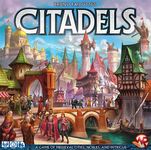
Citadels
Each round, players secretly choose a character — such as the Assassin or Thief — and use that character's ability to build city districts. It's a psychological game where you try to guess which character your opponents picked so you can land an assassination or a theft, and it has stayed a beloved classic for over 20 years.
Rules
Each round, players secretly choose a character card, then use that character's ability to gather resources and build their city. The fun comes from guessing who picked which character so you can land an assassination or a theft — and the game ends the round someone first completes a seven-district city.
Components
| Component | Count | Notes |
|---|---|---|
| Character cards | 27 | All characters across the base 8 plus the advanced/expansion characters |
| District cards | 84 | 54 basic districts + 30 unique (purple) districts |
| Gold coin tokens | 22 | Resource — the rulebook allows substituting coins if the bank runs out |
| Plastic crown | 1 | Marks who controls the character order |
| Ability marker cards | 5 | Warrant/bribe tokens for specific characters |
| Character reminder cards | 27 | Laid out on the table to show which characters are in play |
| Reference cards | 8 | Summaries of character abilities |
Of the 84 district cards: 11 Religious · 11 Military · 12 Noble · 20 Trade · 30 Unique (from the rulebook's District Effect Clarifications intro).
Setup (for 4–8 players)
- 1Lay out the 8 character cards (rank 1 Assassin through rank 8 Warlord) in order in the center of the table.
- 2Shuffle the 14 unique districts together with the 54 basic districts, then deal 4 cards to each player as a starting hand.
- 3Stack the remaining district cards face down as the district deck, with the gold bank beside it.
- 4Each player takes 2 gold from the bank.
- 5The oldest player takes the crown — becoming the crowned player who runs the selection phase this round.
First game: stick to the 8 characters
The rulebook recommends your first game use only the basic 8 characters and 14 unique districts. A 9th-rank character is a variant to consider at 5+ players (see Variants).
Selection phase — secretly choosing a character
- 1The crowned player shuffles the 8 character cards.
- 2Depending on player count, discard a number of cards face up (shown to everyone), and 1 card face down (see the table below). Discarded cards are not used this round.
- 3Starting with the crowned player, look at the remaining cards, secretly keep 1, and pass the rest to the player on your left.
- 4Each player, in turn, looks at the cards, keeps 1 secretly, and passes the rest left, repeating around the table.
- 5The last player's single leftover card is discarded along with the other discarded cards.
| Players | Faceup discards | Facedown discards |
|---|---|---|
| 4 | 2 | 1 |
| 5 | 1 | 1 |
| 6 | 0 | 1 |
| 7 | 0 | 1 (special rule*) |
The rank 4 character cannot be discarded face up
If the rank 4 character (the King family) would be discarded face up, discard a different card instead and shuffle the rank 4 card back into the deck. *With 7 players, the last player who passed also takes the card that was discarded face down at the start of the round, chooses one of the two, and discards the other.
Turn phase and the basic 8 characters
- 1The crowned player calls each character number in ascending order, starting at 1.
- 2If your character is called, reveal it and take your turn — first gather resources: take 2 gold from the bank, or draw 2 district cards and keep 1, discarding the other.
- 3You may then build 1 district card from your hand by paying its cost in gold, placing it face up in your city. You cannot build a district identical (same name) to one already in your city.
- 4Unless the ability specifies a timing, you may use your character's ability at any time during your turn (optional unless the ability says "must").
- 5If a character was killed, or once the revealed player finishes their turn, move to the next number. After 8, the round ends and play returns to the selection phase.
| Rank | Character | Ability summary |
|---|---|---|
| 1 | Assassin | Name another character to kill — that player's entire turn is skipped this round |
| 2 | Thief | Name another character (not the Assassin) to rob — when that character is revealed, take all their gold |
| 3 | Magician | Either swap your entire hand with another player, or discard any number of cards to the bottom of the district deck and draw that many |
| 4 | King | Gain 1 gold per Noble district in your city. You must take the crown during your turn, and will run the selection phase next round |
| 5 | Bishop | Gain 1 gold per Religious district. This round, the rank 8 character cannot destroy your districts |
| 6 | Merchant | Gain 1 gold per Trade district, plus 1 extra gold (regardless of how you gathered resources) |
| 7 | Architect | Draw 2 extra cards regardless of how you gathered resources. Your building limit this turn becomes 3 |
| 8 | Warlord | Gain 1 gold per Military district. May destroy another player's unfinished district by paying one gold less than its cost (not in a completed city) |
A killed character does nothing that round. They gather no resources, build nothing, and use no ability — their entire turn is skipped.
District types and building
- You may normally build only 1 district per turn from your hand (some abilities raise this).
- Trade (green) districts do not count toward your building limit — you can build any number of them in addition to your limit.
- You cannot build a district identical in name to one already in your city (the rulebook notes specific ability exceptions).
- A district in a completed city (7+ districts) cannot be destroyed.
Scoring
| Item | Points |
|---|---|
| Total building cost of your districts | Sum of their costs |
| At least one district of all five types (Noble/Religious/Trade/Military/Unique) | +3 |
| First to complete 7 districts | +4 |
| Each other player who also completes 7 districts (a finished city) | +2 each |
| Unique (purple) district bonuses | Varies per card |
Not only the first to finish scores a bonus
The seven-district bonus isn't only 4 points for the first player — any other player who also reaches 7 districts (a finished city) before the round ends scores 2 points each.
Game end
- 1As soon as someone's city reaches 7 districts, that city is "completed."
- 2The game does not end immediately — it ends after the current round finishes.
- 3Everyone scores their city; the highest total wins.
- 4On a tie, the tied player who revealed the higher-ranked character during the last round wins.
Strategy that follows directly from the rules
- Visibly hoarding gold makes you a target for the Thief. Spending it on districts quickly is one way to avoid that.
- If another player is close to 7 districts, consider using the Assassin to name their character and erase their entire turn.
- Since holding all five district types locks in +3, spreading across colors is often better than stacking only one expensive type.
- The King (rank 4) takes the crown and controls next round's selection order — worth more than its gold income alone.
Player-count variants and editions
| Item | Details |
|---|---|
| 2–3 players | Each player controls 2 character cards, taking one turn per character (sharing one gold stash and one city). The city-completion threshold also rises from 7 to 8 districts. |
| 5–8 players | A 9th-rank character (Queen, Artist, Tax Collector, etc., from the expanded character set) is required at 3 or 8 players and optional at 4–7. This guide covers only the basic 8 characters common to every player count. |
| Editions | 2000 French MultiSim edition (Citadelles) → 2002 Fantasy Flight Games English edition → 2004 Dark City expansion (adds 14 purple unique districts) → the 2016 Z-Man Games new edition (adds 9 new characters and 12 new districts, expanding to up to 8 players). This guide covers the base 8 characters of the 2016 edition — the rulebook itself marks each card with a gem shape for "Citadels Original Game / The Dark City Expansion / Citadels (2016 edition)." |
| Korean release | Korea Boardgames previously published an older (pre-2016) US edition locally, now out of print (per Namuwiki). No official Korean release of the 2016 edition was confirmed. |
Frequently confused rules
Q. Does a killed character really do nothing at all that round?
Yes. They gather no resources, build no district, and use no ability — their entire turn is skipped.
Q. Can a character ability be used any time during a turn?
Yes, unless the ability states a specific timing. Abilities like the Assassin, Thief, or Witch-family characters have fixed timings and only apply then.
Q. Does the game end the instant a city reaches 7 districts?
No. The city is completed immediately, but the game ends only after the current round finishes.
Q. If I don't complete my city first, do I get no bonus at all?
You still can. The first to finish scores 4; any other player who also completes 7 districts before the round ends scores 2 points each.
Q. Can I build two districts with the same name in one city?
No. You cannot build a district identical in name to one already in your city (the rulebook lists a few ability-specific exceptions).
Q. Can I build more than one district in a turn?
Normally only 1. Abilities like the Architect (draw 2, building limit 3) raise the limit, and Trade (green) districts don't count against your limit at all.
History and editions
Designed by Bruno Faidutti, the game was first published in France by MultiSim in 2000 as "Citadelles," with a German edition titled "Ohne Furcht und Adel." It was a finalist for the 2000 Spiel des Jahres, and the Dutch edition, "Machiavelli," won the 2001 Nederlandse Spellenprijs (per English Wikipedia).
The English edition was later published by Fantasy Flight Games, and the 2004 Dark City expansion added 14 purple unique districts. The 2016 Z-Man Games new edition added 9 new characters and 12 new districts, extending support up to 8 players — six of the new characters were designed by young French player Robin Corrèze (per English Wikipedia).
Korea Boardgames previously published an older edition locally, but it is now out of print (per Namuwiki); whether the 2016 edition received an official Korean release was not confirmed in this research.
Sources
Z-Man Games — official Citadels (2016 edition) rulebook (PDF)Wiki cross-check — Wikipedia: Citadels (card game)Wiki cross-check — Namuwiki: Citadels (board game, Korean)Rule summaries are reference content written by us, not quotations from the official rulebook. Always check the official rulebook for exact rules. Diagrams are original schematics, not rulebook illustrations.
Spotted a mistake? Tell us in the comments below →
Last updated 2026-10-10
💡 Master tip
When choosing a character, think less about 'what I want to do' and more about 'how will my opponents read me.' Hold the Thief when gold has piled up, and work backward from who's about to finish their 7th district to figure out who the Assassin should target.
Similar games
Ready for something heavier
If this one has gotten too easy, try these — same feel, one step up in weight.
Tools you can request
Not built yet. Let us know if you want one — it goes on the list.
Final score calculation
Adds up district points plus color bonuses and the completion bonus
Comments
Share your thoughts, report a mistake, or request a tool. No sign-in needed — nicknames are not verified, so anyone can use the same one.
Loading…