Top 97
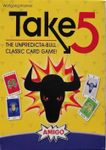
6 nimmt!
Everyone picks a card from their 1–104 deck at the same time, then players attach their cards to one of four rows in ascending order — until someone plays the sixth card in a row and must take the whole row as penalty points. The rules take a minute to learn, but every round brings gasps. A party classic that supports up to 10 players.
Rules
Everyone plays one card at a time, then attaches it to the closest valid end of one of four rows in ascending order. Whoever plays the sixth card in a row takes the whole row as penalty points — a one-minute-to-learn classic.
Components
| Component | Count | Notes |
|---|---|---|
| Number cards | 104 | Numbered 1 through 104, one of each |
| Notepad and pencil | 1 each | Track accumulated penalty points each round |
For 2–10 players, ages 8 and up, about 45 minutes. The player with the fewest penalty points wins.
Setup
- 1Shuffle all 104 cards and deal ten cards to each player.
- 2Reveal four more cards and place each face up in its own column in the middle of the table — these start the four rows.
- 3Each row may hold at most five cards at a time. The remaining cards are not used this round.
Your turn — play simultaneously
- 1Pick one card from your hand and place it face down, all at the same time as everyone else.
- 2Reveal all played cards together.
- 3Starting with the lowest-value card, place each card into a row according to the rules, in ascending order of value.
- 4Repeat for all ten cards in hand until everyone has played their whole hand.
Two rules for placing a card
Rule 1 (Ascending order): your card can only be added to a row where it is higher than the row's last card. Rule 2 (Lowest difference): if more than one row qualifies, you must choose the row where the difference to the last card is smallest.
Two ways to take a row
If your card cannot legally go into any row, or the row it must join is already full with five cards, you take a row. The two situations are handled differently.
Rule 3 — the sixth card
If you must place your card in a row that already has five cards, you take all five cards and add them to your own penalty pile (the bull pile). The card you just played becomes the new first card of that row.
Rule 4 — too low to play
If your card is lower than every row's last card, it cannot be added anywhere. Instead, choose any one row you like and take the whole row. Your card becomes that row's new first card — even a row with fewer than five cards can be taken this way.
Counting bullheads
Every card taken shows bullheads at the top and bottom — each bullhead is one penalty point. The number of bullheads depends on the card's value.
| Card condition | Bullheads (penalty points) |
|---|---|
| Any other number | 1 point |
| Ends in 5 (5, 15, 25…) | 2 points |
| Multiple of ten (10, 20, 30…) | 3 points |
| Double digits (11, 22, 33…) | 5 points |
| 55 (both a multiple of ten and a double) | 7 points |
No 4-point or 6-point cards
There are only five bullhead values: 1, 2, 3, 5 and 7. No card is worth 4 or 6 points.
When a round ends (everyone has played all ten cards), each player totals the bullheads on the cards they took and writes it down.
End and winning
If nobody has reached 66 points after a round, shuffle and start a new round. The moment someone reaches 66 points or more, the game ends immediately, and the player with the fewest total points wins. Ties share the win.
Target score and round count are adjustable
66 is the default target. Agree on a different target score, or a fixed number of rounds, if you want a shorter game.
Strategy tips
- The danger isn't a high number — it's the gap to a row's last card. Avoid holding the value just above a row that already has five cards.
- Working out in advance which row your card would join (and by how much) lets you predict how an opponent's card in between could change things.
- If a low-penalty row is already full, deliberately playing a very low card to trigger Rule 4 is a valid tactic — if you must take a row anyway, take the cheap one.
- If your ten cards are evenly spaced, you risk piling into a single row; factor in the reveal order (lowest first) to guess which row opponents are likely to fill.
Variants
Pro Variant (2–6 players): instead of all 104 cards, use only «number of players × 10 + 4» cards. For example, 3 players use 34 cards (1–34), 4 players use 44 cards (1–44). Each player then picks their own 10 cards face up from the table (four cards are left over to start the rows), and play continues as usual. Since every card in the game is known, it plays more tactically.
The AMIGO 30th Anniversary edition adds four fan-designed special cards (Even/Odd, Mountain Climbing, The Jumping Cow, Flippin' Digits) and a cooperative variant, «Beat the Buffalo». These are optional modules layered on the base rules — the base game alone is enough for a first game.
In Korea, Korea Boardgames distributes the base game, the 30th Anniversary edition, and a variant edition, «6 nimmt!: Bulls & Cows». Rule differences for that variant were not checked for this guide.
Frequently asked questions
Q. Do players take turns playing one card at a time?
No. Everyone plays one card face down simultaneously, then all cards are revealed together. The revealed cards are then placed into rows starting with the lowest value.
Q. If more than one row could legally take my card, can I pick any of them?
No. Rule 2 requires you to place it in the row with the smallest difference to the last card. You can't deliberately choose a farther row.
Q. Can I take a row with fewer than five cards?
Yes. If Rule 4 applies (your card is lower than every row's last card), you may choose and take any row, even one with fewer than five cards.
Q. Are there 4-point or 6-point bullhead cards?
No. The only bullhead values are 1, 2, 3, 5 and 7.
Q. Does the game end exactly at 66 points?
No. The game ends as soon as a round finishes with someone at 66 points or more — the total doesn't need to be exactly 66.
Q. Can a round end before everyone has played all their cards?
No. A round continues until every player has played all ten cards in hand.
History and editions
Designed by Wolfgang Kramer, first published by AMIGO in 1994. It won the Deutscher Spiele Preis that year and was a Spiel des Jahres recommendation. In English-speaking markets it is distributed by Hasbro and also known as Take 5 or Category 5.
Ahead of its 30th anniversary, AMIGO ran a worldwide fan contest in 2019 for the "best 6 nimmt! special card," and the winning design, Even/Odd, along with three other fan-created special cards and a cooperative variant, "Beat the Buffalo," were later added to anniversary printings. The base game rules themselves remain unchanged from the 1994 original.
In Korea, Korea Boardgames officially imports and sells the base game, the 30th Anniversary edition, and the variant edition «6 nimmt!: Bulls & Cows».
Sources
Official AMIGO English rulebook (30th Anniversary edition) — PDF pages 4–9Cross-checked against Wikipedia: 6 nimmt! (designer, 1994 release, awards, alternate names)Korea Boardgames — 6 nimmt! product page (confirms a licensed Korean edition)Rule summaries are reference content written by us, not quotations from the official rulebook. Always check the official rulebook for exact rules. Diagrams are original schematics, not rulebook illustrations.
Spotted a mistake? Tell us in the comments below →
Last updated 2026-10-10
💡 Master tip
The danger isn't a high number — it's the gap to a row's last card. Never hold the value that sits right above a row that already has five cards, and deliberately playing a low card early to use your 'free choice of row' and reset a low-penalty row is also a valid technique.
Ready for something heavier
If this one has gotten too easy, try these — same feel, one step up in weight.
Tools you can request
Not built yet. Let us know if you want one — it goes on the list.
Penalty point tracker
Records bullhead penalty points each round to track progress toward 66 points
Comments
Share your thoughts, report a mistake, or request a tool. No sign-in needed — nicknames are not verified, so anyone can use the same one.
Loading…