Top 137
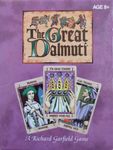
The Great Dalmuti
A game about social class where you play cards — the lower the number, the stronger — and race to empty your hand first. The heart of it is the rank structure: at the end of every hand, seats and privileges change according to how you placed, from the Greater Dalmuti (the king) down to the Greater Peon, and it is a party classic that keeps everyone laughing with no waiting around.
Rules
A game about social class in which the lower the number, the better the card. The order in which players run out of cards decides their rank in the next hand, and the higher your rank, the more taxes you collect. A structure that is unfair on purpose — the player who is ahead gets more help — is the whole of this game.
80 cards — the number is also the count
The lower the number, the better the card
A card's number is called its rank. 1 is the strongest and 12 the weakest. And the number is also how many of that card are in the deck: there is a single rank 1 card and there are twelve rank 12 cards.
| Rank | Card | Count |
|---|---|---|
| 1 | The Great Dalmuti | 1 |
| 2 | Archbishop | 2 |
| 3 | Earl Marshal | 3 |
| 4 | Baroness | 4 |
| 5 | Abbess | 5 |
| 6 | Knight | 6 |
| 7 | Seamstress | 7 |
| 8 | Mason | 8 |
| 9 | Cook | 9 |
| 10 | Shepherdess | 10 |
| 11 | Stonecutter | 11 |
| 12 | Peasants | 12 |
| Jester | Wild card | 2 |
The Jester cuts both ways
Played together with other cards, it takes on their rank. But played alone it counts as rank 13, worse than even the Peasants (12) — the worst card in the game.
Seating and the deal
- 1Shuffle the deck and fan it out, then everyone draws one card and reveals it.
- 2Whoever drew the best (lowest) card is the Greater Dalmuti and picks the seat they want first.
- 3The second-best card is the Lesser Dalmuti, who sits to the Greater Dalmuti's left. Seating continues clockwise the same way.
- 4The player with the worst card is the Greater Peon, and the player to their right is the Lesser Peon. Everyone else is a Merchant.
- 5Break ties by drawing more cards. Jesters count as the worst cards possible.
The Greater Peon deals
Deal the whole deck out one card at a time, clockwise, starting with the Greater Dalmuti, until it runs out. So players may end up holding different numbers of cards. Life isn't fair, after all. You may look at your hand while the cards are still being dealt.
Five to eight players is best. Four, or nine and up, also works.
Taxation — the heart of the game
- 1The Greater Peon picks the two best cards in their hand and gives them to the Greater Dalmuti.
- 2The Greater Dalmuti picks any two cards from their hand and gives them to the Greater Peon.
- 3The Lesser Peon and the Lesser Dalmuti do the same, but with one card each.
- 4All exchanges happen at the same time.
Revolution — if you are dealt both Jesters
A player dealt both Jesters may call a revolution, and there is no taxation that hand. If the Greater Peon calls it, it becomes a greater revolution: everyone swaps seats with their opposite. The Greater Peon becomes the Greater Dalmuti, the Lesser Peon becomes the Lesser Dalmuti, and so on.
The play — same count, better rank
- The player with the lead plays a set of cards of the same rank face up. A single card is a set too. The Greater Dalmuti has the lead in the first hand.
- Going clockwise, each player must play the same number of cards at a better (lower) rank, or pass.
- Passing does not lock you out — you may play again when your turn comes around.
- When everyone passes in a row, the round ends. The Greater Peon clears the played cards away, and the player who made the last play takes the lead.
Passing when you could play is a strategy
Most of the time you shed your worst cards first, but from a low position it is often better to save a good set until several players are out and use it to take the lead. If you only want to climb one rank or hold the position you have, saving cards pays.
Ranks change at the end of the hand
- Playing your last card is called going out. The first player out becomes the Greater Dalmuti for the next hand.
- The second player out becomes the Lesser Dalmuti and sits to the Greater Dalmuti's left, and so on around the table.
- Play continues after someone goes out. If nobody can play a better set, the lead passes to the next player who still has cards.
- The basic rules have no overall winner. Becoming the Greater Dalmuti is winning and becoming the Greater Peon is losing.
If you want to keep score (official optional rule)
Each time you go out you score 1 point for every player still holding cards. Agree on a number of hands in advance (twenty is a fine start); the highest total wins.
Official optional rules
- First deal revolution — the first hand is automatically a revolution, so no taxes are collected. If the Greater Peon holds both Jesters, they may still call a greater revolution.
- Stripped decks for fewer players — with five players remove the Peasants for a 68-card deck; with four remove the Peasants and the Stonecutters for 57 cards.
- Philanthropic scoring — on top of the scoring rule above, the Greater Dalmuti gets 1 point if the Greater Peon goes up in status, and the Lesser Dalmuti gets 1 point if the Lesser Peon does.
- Merchant exchange — during taxation the highest-class Merchant takes one card at random and swaps it with a Merchant of their choice.
- More appropriate seating — the Greater Dalmuti gets the best chair and the Greater Peon sits on a box or on the floor. Pick snacks in rank order too.
- Misdeals — if the Greater Peon accidentally exposes a card while dealing, the Greater Dalmuti decides whether it goes to the intended player or to the Greater Peon. If the Greater Peon keeps it, they replace it with a card drawn at random from their own hand.
A new player can join a game in progress. They come in at the start of the next hand as a Merchant, halfway between the Greater Dalmuti and the Greater Peon. If there is a choice of positions, the Greater Dalmuti decides.
Commonly confused rules
Q. Is 1 the strongest card, or 12?
1 is the strongest. The lower the number, the better. The number is also the count of that card, so the stronger a card is, the fewer of them there are.
Q. Can I play 2 cards on top of 3?
No. The count must match exactly; only the rank has to be lower.
Q. I passed — can I play again on my next turn?
Yes. Passing only skips that turn; it does not drop you out of the round.
Q. Can the Greater Peon pay tax with bad cards?
No. They must give their two best cards. Only the Greater Dalmuti gets to choose.
Q. Can I play more than one Jester at a time?
Two Jesters played with other cards all count as that rank. One rank 5 card plus two Jesters, for example, is three rank 5 cards.
Q. Can anybody call a revolution?
Only a player dealt both Jesters. If the Greater Peon calls it, it becomes a greater revolution and the whole class order flips.
Q. Is it fine that players hold different numbers of cards?
That is the rule. The deal continues until the deck runs out, so the players near the front (the higher ranks) get an extra card. The unfairness is intended.
History and editions
| Item | Detail |
|---|---|
| Designer | Richard Garfield — creator of «Magic: The Gathering» |
| Illustration | Margaret Organ-Kean |
| Publisher | Wizards of the Coast, February 1995 |
Garfield writes in the rulebook that a friend taught him the game in graduate school. There was no winner and no score at first — just seeing who could hold the Dalmuti's seat longest — and he and his friends added scoring later.
Games from the same root
The ancestor of this family appears to be the Chinese game «Zheng Shang You» (Climbing Up), and it spread under different names from place to place — «Dai Hin Min» (A Very Poor Man) in Japan, «Rich Man–Poor Man» in Alaska, «Scum» in Utah. Garfield said the name «Dalmuti» came from «Dai Hin Min». In Korea it tends to be introduced alongside «Blue Marble»-style class games and «Big Two».
| Edition | Released | Notes |
|---|---|---|
| Base game | 1995 | Wizards of the Coast |
| Dungeons & Dragons Edition | 2020 | Rethemed for D&D, illustrated by Harry Conway |
Sources
Official Wizards of the Coast rulebook (The Great Dalmuti, English)Wiki cross-check — Wikipedia: The Great DalmutiWiki cross-check — Namuwiki: DalmutiRule summaries are reference content written by us, not quotations from the official rulebook. Always check the official rulebook for exact rules. Diagrams are original schematics, not rulebook illustrations.
Spotted a mistake? Tell us in the comments below →
Last updated 2026-09-14
💡 Master tip
Get rid of high cards (11s and 12s) that are down to singles early, while you still have the lead. If you are left holding single high cards late, that hand sends you to Peon.
Ready for something heavier
If this one has gotten too easy, try these — same feel, one step up in weight.
Tools you can request
Not built yet. Let us know if you want one — it goes on the list.
Finishing order log
Record the order players emptied their hands each hand to track how the ranks change
Comments
Share your thoughts, report a mistake, or request a tool. No sign-in needed — nicknames are not verified, so anyone can use the same one.
Loading…