Top 33 · #9 of 29 in Party
Dixit
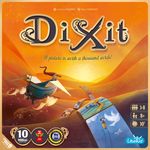
Study dreamlike picture cards as the storyteller gives a word, phrase, song, or gesture inspired by one hidden image. The clue must guide some players to the answer without making it obvious to everyone. Winner of the 2010 Spiel des Jahres, Dixit established the modern picture-association party game.
Rules
Give a clue inspired by one picture, then aim for the narrow middle where some players understand it while others are drawn to convincing decoys.
The storyteller wants some guesses, but not all
One player is the storyteller each turn and gives a clue for one picture in their hand. Everyone else submits a similar picture as a decoy, then tries to find the storyteller's card. The storyteller earns the main score only when at least one player, but not everyone, finds it.
Set up the 84-card, eight-player edition
First storyteller
After setup, the first player to think of a clue for a riddle becomes the first storyteller. The role then passes to the left after every turn.
Step 1 — one hidden card and one clue
- 1The storyteller secretly selects one of the six cards in their hand.
- 2They say a word or phrase inspired by its picture.
- 3The clue may be invented or borrowed from a poem, song, film, or proverb. It may even be sung, mimed, or expressed as a sound.
Create a connection instead of listing objects
Naming the most visible object makes a unanimous answer likely. A shared memory, mood, or indirect association can be recognizable to some players without giving the card away to everyone.
Step 2 — shuffle in the decoys
Each non-storyteller secretly chooses the card in their hand that best illustrates the clue and gives it face down to the storyteller. The storyteller shuffles those decoys with the answer, then places the cards face up at random beside the numbered card slots.
Keep both pictures and owners hidden
If a player can track who submitted a card while the cards are collected or shuffled, the vote breaks down. Hide every card face and its owner until the tableau is ready.
Step 3 — everyone except the storyteller votes
Once every dial is visible, the storyteller identifies the answer. First use the distribution of votes on that card for the main score, then add the votes attracted by each decoy as bonuses.
Step 4 — score the answer and decoys separately
| Votes on the answer | Storyteller | Other players' main score |
|---|---|---|
| Everyone or nobody | 0 | 2 each |
| Some, but not all | 3 | 3 if correct; 0 if wrong |
| Votes on a decoy | Not applicable | +1 per vote on your own card |
Step 5 — discard and refill to six
Reshuffle if there are too few cards
If the draw pile cannot give one card to every player, shuffle its remaining cards together with the discard pile to create a new draw pile.
Three-player rules
- Each non-storyteller still casts only one vote.
- A non-storyteller gets 1 bonus point if either of their two cards receives a vote.
- At turn end, the storyteller draws one card and each other player draws two, restoring seven-card hands.
Check 30 points at the end of the turn
Reaching 30 first is not an immediate win
Several players can pass 30 during the same turn. Apply every player's main score and decoy bonuses before comparing their final positions.
The 2008 original and 2021 refresh
Designed by Jean-Louis Roubira and illustrated by Marie Cardouat, Dixit was published by Libellud in 2008 and won the 2010 Spiel des Jahres. Korea Boardgames released a Korean edition in 2011. The current 2021 refresh expands the base game's rabbit pawns and voting dials to support three to eight players.
The base game and each expansion contain 84 distinct picture cards. Expansion cards can replace or mix with the base deck, but an expansion alone does not provide the scoring track, voting dials, and rabbit pawns needed to play.
Korean rulebook text not yet verified
The current Korean product's player count, age, duration, and official terminology were checked. Detailed values and rulings follow Libellud's 2021 English rulebook; the physical Korean rulebook takes precedence if its wording differs.
Frequently confused rules
Q. Does the storyteller vote?
No. The storyteller only reveals which card was theirs after every other player has voted.
Q. Do decoy bonuses apply when everyone guesses correctly?
Yes. Every non-storyteller first scores 2, then adds 1 point for each vote their decoy received.
Q. Must a clue be one word?
No. It may be a phrase of any length, a song, a mime, or an onomatopoeia.
Q. Does the first rabbit to reach 30 win immediately?
No. Finish scoring the turn, then compare all scores. Tied leaders share the victory.
Q. In a three-player game, can my two decoys earn 2 bonus points?
No. Only the other non-storyteller can vote for one of your cards, so receiving a vote gives you 1 bonus point.
Sources
Libellud official English rulebook for the 2021 Dixit refresh (4 pages)Libellud official Dixit product pageAsmodee official Dixit 2021 Refresh product pageKorea Boardgames official Dixit product page — Korean 3–8 player editionKorea Boardgames official feature — Korean release and expansion historyBoardGameGeek — Dixit players, time, weight, and awardsWiki cross-reference — Wikipedia: Dixit (board game)Wiki cross-reference — NamuWiki: DixitRule summaries are reference content written by us, not quotations from the official rulebook. Always check the official rulebook for exact rules. Diagrams are original schematics, not rulebook illustrations.
Spotted a mistake? Tell us in the comments below →
Last updated 2026-09-15
💡 Master tip
As storyteller, aim for a clue that is recognizable to part of the group but leaves room for convincing decoys. When voting, compare the clue with every picture and consider which associations fit the storyteller's habits rather than choosing the most literal image automatically.
Similar games
Ready for something heavier
If this one has gotten too easy, try these — same feel, one step up in weight.
Tools you can request
Not built yet. Let us know if you want one — it goes on the list.
Voting and score tracker
Collects secret votes and totals the main score plus decoy bonuses
Comments
Share your thoughts, report a mistake, or request a tool. No sign-in needed — nicknames are not verified, so anyone can use the same one.
Loading…