Top 9 · #3 of 19 in Co-op
Spirit Island
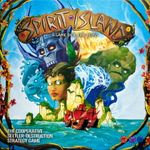
A cooperative game where you play the island's native people and its spirits, driving off the colonial invaders who foul and invade the island with fear and magic. The asymmetry of spirits with very different powers, and the freedom they give you, have built a devoted following.
Rules
A cooperative game for 1-4 players in which you are the spirits of an island driving off colonial Invaders. The heart of it is that the Invaders run themselves: each turn every Invader Card slides one space to the left, so a terrain Explored this turn is Built on next turn and Ravaged the turn after, and the spirits work inside those two turns of warning.
How the game is built
Spirit Island is a cooperative game for 1-4 players. You are the nature spirits of an island, and your job is to stop the Invaders who have sailed in to colonize it and who spread Blight as they go. The Dahan, the island's own people, are not on the Invaders' side - they live alongside the spirits.
Nobody plays the Invaders. They are driven entirely by the Invader Deck and the Invader Board. Each turn one card enters the Explore space and every card already on the board slides one space left, triggering Builds and Ravages. So this is not a game about not knowing what the opponent will do - it is a game where you already know which lands will be Ravaged two turns from now.
- Every phase is played simultaneously. Talking it through and agreeing is part of the rules.
- Every spirit has its own Growth options, Presence Tracks, and Innate Powers. The asymmetry is the game.
- The victory condition is not fixed - it gets easier as the Terror Level rises. Frightening the Invaders is how you lower the bar for winning.
- It is a heavy game. The rulebook itself suggests that your first game or two use a low-complexity spirit with its Power Progression Card, and leave out the Blight Card, Adversaries, and Scenarios.
Recommended setup for your first games
The rulebook names four low-complexity spirits: Lightning's Swift Strike, Vital Strength of the Earth, River Surges in Sunlight, and Shadows Flicker Like Flame. It adds that Shadows Flicker Like Flame is the trickiest of the four.
Components
| Component | Count | Notes |
|---|---|---|
| Invader Board | 1 | Fear Pool, Fear Deck, Blight Space + the Ravage / Build / Explore Action Spaces |
| Island Boards | 4 | Standard map on the front, thematic map on the back (for experienced players) |
| Spirit Panels | 8 | Growth, Presence Tracks, and Innate Powers differ for every spirit |
| Unique Power Cards | 32 | 4 per spirit |
| Minor / Major Power Cards | 36 / 22 | Separate decks, each with its own discard pile |
| Invader Cards | 15 | Only 12 are used in a game (3 Stage I, 4 Stage II, 5 Stage III) |
| Fear Cards | 15 | Only 9 are drawn for a game |
| Terror Level dividers | 2 | They split the Fear Deck into three groups of three |
| Blight Cards | 2 | “Healthy Island” on the front, “Blighted Island” on the back |
| Adversary panels / reminder tiles | 3 / 3 | Brandenburg-Prussia, England, Sweden |
| Scenario cards | 4 | The number in the upper-right corner is the difficulty rating |
| Power Progression Cards | 4 | For beginners - a fixed order instead of “draw 4, keep 1” |
| Reference cards | 8 | 2 kinds x 4 |
| Cities / Towns / Explorers | 20 / 32 / 40 | 3 / 2 / 1 Health, and 3 / 2 / 1 Damage on Ravage |
| Dahan | 36 | 2 Health, 2 Damage when fighting back. Each board starts with 6 |
| Blight | 38 | Split between the Blight Card and the island setup |
| Spirit Presence | 52 | 4 colors x 13 |
| Single-Turn Effect Markers | 12 | 4 colors x 3. The back face is the “Defend” side |
| Energy markers | 32 | 20 of value 1, 12 of value 3 |
| Fear Markers | 20 | A game uses 4 per player |
Running out of pieces does not matter
The number of Invaders and Dahan is not limited by the supply of models. If you run out, the rulebook tells you to stand in Energy markers instead.
Setup
- 1If you are using an Adversary or a Scenario, choose it before setup - some of them change setup itself.
- 2Put out the Invader Board and place 4 Fear Markers per player in the Fear Pool.
- 3Shuffle the Fear Cards and place 9 on the Fear Deck space, divided into three groups of three: put the “Terror Level 2” divider between the top and middle groups, and the “Terror Level 3” divider between the middle and bottom groups.
- 4Build the Invader Deck: 5 Stage III cards, then 4 Stage II on top of them, then 3 Stage I on top, and set it on the Explore space. One card of each stage is left over - return those to the box without looking at their faces.
- 5Take one Blight Card at random without looking at its back, place it “Healthy Island” side up on the Blight Space, and stack the indicated amount of Blight on it.
- 6Pick one Island Board per player at random, lay them out, and populate each land with the Invaders, Dahan, and Blight shown by its icons. This Blight comes from the box, not from the Blight Card.
- 7Shuffle the Minor and Major Power Decks separately and put the Energy, Cities, Towns, Explorers, and Dahan where everyone can reach them.
- 8Each player takes all Presence and Single-Turn Effect Markers of one color, then chooses a spirit and takes its Spirit Panel and 4 Unique Power Cards.
- 9Place starting Presence following the setup instructions on the back of the Spirit Panel. Every player starts on a different Island Board.
- 10Flip the Spirit Panels face up and cover every dashed circle on both Presence Tracks with your remaining Presence. The leftmost solid circle on each track stays uncovered.
- 11Finally, the Invaders' starting action: reveal the top Invader Card, resolve the Explore action in that terrain, and place the card face up on the Build space.
Adjacency is generous
Two lands are adjacent whenever they touch - even across different Island Boards, even if they only meet at a corner. The Ocean is not a land and is not in play, but lands adjacent to the Ocean are Coastal, and that definition feeds straight into the Explore rules.
The five phases of a turn
- 1Spirit Phase - (1) choose one Growth option at the upper right of your Spirit Panel and do everything in it, in any order you like. (2) Gain Energy equal to the highest uncovered number on your Energy Presence Track. (3) Choose the Power Cards you will play this turn and pay for them immediately. You gain the Elements on those cards right away - the card effects wait.
- 2Fast Power Phase - resolve Fast Powers. You may agree on the order, but you may not interrupt one Power with another. A Fast Power you do not use now cannot be held back for later.
- 3Invader Phase - (1) Blighted Island effect, if it applies, (2) Fear effects, (3) Invader Actions (Ravage, then Build, then Explore), (4) advance the Invader Cards.
- 4Slow Power Phase - resolve Slow Powers exactly as in the Fast Power Phase.
- 5Time Passes - discard the Power Cards you played to your personal discard pile, clear every Element gained and all Damage dealt this turn (stand the tipped models back up), and remove the Single-Turn Effect Markers.
Fast Powers cannot be saved
“Fast” and “Slow” are not a choice, they are when the Power resolves. Fast Powers only happen before the Invader Phase and Slow Powers only after it. If an effect made a Slow Power Fast and you used it early, you cannot use it again in the Slow Power Phase.
Who decides?
When a choice such as “which land does the Blight cascade into” does not say who makes it: if the choice came out of a Power, the spirit who used that Power decides; otherwise the players agree. In the rare case where you cannot agree, land-related choices go to the spirit whose starting board it is, and everything else to whoever owns or is hosting the game.
The Invader Board - two turns from Explore to Ravage
The Invader Board has three Action Spaces - Ravage, Build, and Explore - with a discard space to their left. The Invader Card sitting in a space tells you which land type that action affects. If a space is empty, that action simply does not happen this turn.
| Explore | Build | Ravage | |
|---|---|---|---|
| Turn 1 | Sands | · | · |
| Turn 2 | · | Sands | · |
| Turn 3 | · | · | Sands |
3a. Ravage - in each land of the type shown on the Ravage card, the Invaders deal Damage to the land and the Dahan simultaneously, and the surviving Dahan fight back. The arithmetic is in the next section.
3b. Build - in each land of the type shown on the Build card, add 1 City if the land has more Towns than Cities, and 1 Town in all other cases. You are not upgrading a Town into a City, you are adding a new piece. Do not Build in lands without Invaders.
3c. Explore - turn the top card of the Invader Deck face up. In lands of that type, add 1 Explorer if the land contains a Town or City, or is adjacent to a Town, City, or Ocean. Only 1 Explorer goes in no matter how many sources are adjacent, and it comes from the supply. If there is no card to turn up, you lose on the spot.
Ravage and Build only happen where Invaders already are
Ravage and Build require Invaders in the land; Explore reaches out from Invader sources (Towns and Cities) and from the Ocean. What all three share is that they only happen in the land type printed on that space's Invader Card. Stage III cards show two terrains joined by a “+”, so a Stage III card makes its action happen in both.
Ravage and Blight - why this game hurts
In each land of the Ravage card's type, the Invaders deal Damage to the land and the Dahan at the same time: 1 per Explorer, 2 per Town, 3 per City, reduced by any Defend Powers played. Then two things happen together.
- Damage to the land - if it is 2 or more, add 1 Blight to the land. Only ever one, no matter how large the Damage. If it is 1 or less, nothing happens.
- Invaders fight the Dahan - every 2 Damage destroys 1 Dahan. You may not spread the Damage around to keep them alive. A Dahan dealt only 1 Damage is turned over to show it, and surviving Dahan recover at the end of the turn.
- The Dahan fight back - once the Invaders' Damage is fully resolved, each surviving Dahan in that land deals 2 Damage to the Invaders there, divided as you choose. Dahan whose Damage was entirely absorbed by Defend still fight back. If the Ravage in that land was skipped or stopped, though, there is no counterattack either.
- The Invaders never attack the spirits directly. Presence does not fight back either. The only way Presence dies is Blight being added to its land.
Adding Blight does two bad things at once. First, it destroys 1 Presence from each spirit in that land - and destroyed Presence is removed from play, never returned to the Spirit Panel. Second, if the land already had Blight, you must add a Blight to one adjacent land as well (a Cascade). If that adjacent land also had Blight, it cascades again, and so on.
This is where people get it wrong
The rulebook warns about it directly: (1) a Ravage adds only 1 Blight to a land regardless of how much Damage was dealt, and (2) a Cascade goes into exactly one adjacent land (not all of them). Getting either wrong makes the game absurdly hard.
Removing is not Destroying
Destroying generates Fear (1 for a Town, 2 for a City). Removing and replacing do not - the piece is just taken to have fled. Blight taken off the island goes back onto the Blight Card, but once that card has flipped to “Blighted Island”, it never flips back, no matter how much Blight you clear.
Spirits, Growth, and Presence Tracks
A Spirit Panel carries Growth options, two Presence Tracks, and Innate Powers. Each turn you pick one Growth section and do everything in it, in whatever order you like. The common Growth effects are these.
| Growth effect | What it does |
|---|---|
| Add Presence | Place 1 Presence from your panel into a land at Range 2 |
| Gain Energy | Gain 2 Energy, in addition to this turn's normal Energy income |
| Gain a Power Card | Draw 4 and keep 1 from either the Minor or the Major Power Deck |
| Reclaim | Return all Power Cards from your personal discard pile to your hand |
The top Presence Track is Energy gained per turn and the bottom one is Card Plays. At setup everything but the leftmost space on each track is covered by Presence. When you place Presence on the island you choose which track to take it from, always from the left, and the bigger numbers appear as the track empties. You do not add the tracks together - you use the highest revealed number on each track.
- A Sacred Site is a land where one spirit has 2 or more Presence. Some Powers can only be used from a Sacred Site, and one land can be a Sacred Site for several spirits at once.
- There is no limit to how much Presence, or how many different spirits' Presence, a land can hold.
- Destroyed Presence never comes back. It does not return to the Spirit Panel and it never re-covers a track number.
- Some tracks have a “Reclaim One” space. While it is revealed you may return 1 Power Card from your discard pile to your hand during any Spirit Phase, starting the very turn it is revealed.
- Some tracks carry bonus Elements. While revealed, you count as having that Element every turn. An “Any” space grants one Element of your choice each turn, but you cannot change it mid-turn.
- Instead of adding Presence from your panel you may move one of your Presence already on the island to the same destination - useful once all your Presence is out.
Energy and Card Plays are personal
Energy belongs to you and cannot be transferred between spirits; unspent Energy carries over to the next turn. Card Plays likewise cannot be shared, and unlike Energy they do not carry over.
Power Cards and Elements
- 1**Energy cost** - Power Cards only. You pay it the moment you play the card.
- 2**Name** - a few Powers refer to one another by name.
- 3**Elements** - gained the moment you pay for the card, and they clear during Time Passes.
- 4**Speed** - a red circle means Fast, a blue circle means Slow.
- 5**Range** - how many lands away from your Presence it can reach. It is a **maximum**, so you may always act closer. Range 0 means the land your Presence is in.
- 6**Target** - which lands it may be used on. Unless stated, a Power targets **a single land**.
- 7**Effects** - resolved in order, skipping anything that cannot be done.
- 8**Elemental Thresholds** - extra effects that only fire on turns you have gained the listed Elements. Elements are **never spent, only checked**.
There are eight Elements: Sun, Moon, Fire, Air, Water, Earth, Plant, and Animal. Playing a Power Card grants the Elements printed on it immediately, and they go away when the card leaves play (usually during Time Passes). Innate Powers cost no Energy and no Card Plays - they demand Elements instead.
| Kind of Power | Where it lives | Cost |
|---|---|---|
| Innate Power | Printed on the Spirit Panel | No Energy, no Card Play. Usable every turn the Elements line up |
| Unique Power Card | 4 per spirit | Energy. Only that spirit has these cards |
| Minor Power Card | Shared deck of 36 | Energy. Cheap and narrow |
| Major Power Card | Shared deck of 22 | Energy. Gaining one forces you to Forget a Power Card |
One land! One turn! One use!
The rulebook prints these three as a heading. (1) A Power affects one target land - “destroy up to 3 Explorers” means up to 3 in a single land. (2) It affects only this turn - the only permanent changes are pieces actually moved on the board. (3) It can be used once this turn - paying double Energy or holding double the Elements does not buy a second use.
- “Up to” is not the same as a fixed number. “Up to 3” may be 0, 1, 2, or 3; a plain “3” must be done as fully as you are able.
- Do as much as you can. If part of an effect cannot be applied, skip that part and resolve the rest.
- You may skip a Power entirely. You do not get the Energy back, but the Elements from the card still count - playing a card purely for its Elements is a real tactic.
- Gather moves things into the target land from adjacent lands; Push moves them out into adjacent lands. Both move things exactly one land, and boosts to a Power's Range do not extend them. You may not Push off the board or into the Ocean.
- Repeat does not grant Elements again and never chains (ignore the word “Repeat” on the repeated card). It also does not count as another Card Play.
- Forget may take a card from your hand, your discard pile, or cards in play - including a Major Power you have only just gained. A Forgotten Unique Power goes under your Spirit Panel.
Fear and the Terror Level
Fear is fright done to the Invaders. It comes from Powers carrying the Fear symbol and from destroying Invaders - 1 Fear for a Town, 2 for a City. For each Fear generated, advance one Fear Marker from the Fear Pool into the Generated Fear area.
- 1When all the Fear Markers have advanced, move the top card of the Fear Deck face down into the Earned Fear Cards area.
- 2If that reveals a Terror Level divider, move it to cover the old Terror Level. The new Terror Level and victory condition apply immediately - you can win on the spot.
- 3Move all the Fear Markers back to the Fear Pool. Any leftover Fear is then advanced again.
- 4Earned Fear Cards are resolved during the next Invader Phase, in the order they were earned, using only the row for the current Terror Level. Resolved cards go to the Fear Discard space.
A Fear Card uses the Terror Level of the turn it is resolved
The Terror Level can rise between earning a Fear Card and resolving it. Both rulebooks are explicit: you use the effect for the Terror Level at the time of resolution. If resolving Fear earns you another Fear Card, put it at the bottom of the stack you are working through and resolve it last.
Fear effects mostly Remove
Fear effects tend to drive Invaders away rather than destroy them, and Removing generates no Fear - so Fear does not easily snowball into more Fear. Most Fear effects tell “each player” to do something, and one player finishes their share before the next begins.
Victory and defeat
You win immediately the moment you meet the victory condition for the current Terror Level - the Invaders have had more than they can bear and abandon the island. The condition gets easier as the Terror Level rises.
| Terror Level | Victory condition |
|---|---|
| 1 (start) | Win when no Invaders remain on the island |
| 2 | Win when no Towns or Cities remain (Explorers may stay) |
| 3 | Win when no Cities remain |
| - (bottom row of the Invader Board) | “Terror Level Victory - you win immediately!” |
When does that fourth row trigger?
The victory-condition column on the Invader Board has a fourth row reading “Terror Level Victory - you win immediately!”. However, an unverified point: neither the Korean rulebook's body text nor the English Rules Reference explains when that row fires. Both glossaries define the Terror Level as “a number from 1 to 3”. Until it is confirmed, do not build a plan around it.
- Too Much Blight - when the last Blight comes off the Blight Card, follow its instructions. From the “Healthy Island” side you flip the card; from the “Blighted Island” side, you lose.
- A Spirit Is Destroyed - if any spirit has no Presence left on the island, that spirit is destroyed and all players lose.
- Time Runs Out - if you need to draw an Invader Card to Explore and the deck is empty, you lose.
Sacrifice Victory
Rarely a single effect satisfies a victory condition and a defeat condition at the same time. That counts as a win - you are destroyed, but the island, the Dahan, and the other spirits survive.
Strategy that falls straight out of the rules
- Clear Explorers before the Build. A land holding only Explorers gets a Town; a land holding nothing gets nothing. The rulebook calls this an extremely effective tactic.
- Read two turns ahead. A terrain Explored this turn is Built in next turn and Ravaged the turn after. That forecast is how you choose targets for Slow Powers.
- The terrains on Build and Ravage are the urgent ones. The terrain on Explore still has two turns of slack.
- Keep Presence out of lands about to be Ravaged. Blight there destroys Presence, and a spirit with no Presence loses the game for everybody.
- Build Sacred Sites near the Invaders. Many damaging Powers and strong Fear effects require one.
- Move Dahan into lands with a moderate Invader presence. They counterattack after a Ravage and they satisfy Fear-effect conditions. Do not stack them where the Invaders are overwhelming - one Ravage wipes them out.
- Pour several spirits' Damage into the same land. Damage accumulates within a turn, so three separate “1 Damage” effects bring down a City.
- If you cannot find a good target, it means one of two things: victory is close, or your Presence and Sacred Sites are too far from the fight.
- If Energy is always short, take more Presence off the Energy track, spend fewer Card Plays, choose cheaper cards, or pick a Growth option that grants Energy.
If you are losing badly
The rulebook offers two official ways to soften the game: (1) every spirit takes one bonus Growth after setup, before play begins, or (2) skip the Invaders' starting Explore during setup. You may use both.
Do not rewind mistakes
The rulebook is blunt about this: if you discover four turns later that you targeted an illegal land, do not worry about it. The game simply got slightly easier or harder. Check the correct rule and carry on.
Difficulty dials and variants
Spirit Island treats difficulty as a number. Adversaries and Scenarios each carry a difficulty rating, and you may use one, the other, or both. If their rules changes contradict each other, the Scenario takes precedence.
| Adversary (3 in the base game) | Character | Notes |
|---|---|---|
| The Kingdom of Brandenburg-Prussia | Speed | Recommended as your first Adversary - very few new rules, with most changes happening during setup |
| The Kingdom of England | Buildings | It pushes its borders forward relentlessly. Easier for spirits good at wrecking Towns, and notably harder for spirits that rely on moving or killing Explorers |
| The Kingdom of Sweden | Ravage | Its Ravages are more dangerous than most. It can add Blight during setup, and that Blight neither Cascades nor destroys Presence |
- Each Adversary has levels 1-6, and the effects are cumulative - at level 3 you also use the level 1 and 2 effects.
- Every Adversary panel carries an Escalation effect for Stage II. It fires when the escalation icon is revealed on a Stage II Invader Card, and unless stated otherwise it resolves before the Explore.
- Higher levels change how many Fear Cards are used and how they are split between top, middle, and bottom - from 9 (3/3/3) up to 14 (4/5/5), making high Terror Levels harder to reach.
- Some Adversaries add an extra loss condition (England, for example, wins if 7 or more Towns and Cities pile into a single land).
- Four Scenarios - Blitz, Guard the Isle's Heart, Rituals of Terror, and Dahan Insurrection. Difficulty ratings run from 0 (no change) to 10 (insanely difficult).
- Thematic boards - the reverse side of the Island Boards, the island as it “really” is. Terrains clump together and there are more starting Invaders, which raises difficulty by 3. The layout is fixed per player count (1 player Northeast; 2 players West and East; 3 players those plus Northeast; 4 players all four).
- Solo play uses a single Island Board. You may target yourself with Powers that say “another Spirit”, but you do not gain the extra benefits such Powers give when used on someone else.
| Scoring (optional) | Formula |
|---|---|
| Victory | 5 x difficulty + 10 + 2 per Invader Card remaining in the deck |
| Defeat | 2 x difficulty + 1 per Invader Card not in the deck (discard plus the face-up Action Spaces) |
| Either way | +1 per X living Dahan, -1 per X Blight on the island (X = number of players) |
Expansions
Branch & Claw, Jagged Earth, Feather and Flame, and Nature Incarnate all have Korean editions from BoardM Factory, whose rulebooks sit on the same product page. The token icons printed on some thematic-board lands belong to Branch & Claw and are ignored when playing the core game alone.
Rules people get wrong
Q. Do the Invaders attack my Presence?
No. During a Ravage the Invaders damage only the land and the Dahan. They never attack a spirit directly, and Presence never fights back. The single way Presence dies is Blight being added to its land.
Q. A land took 6 Damage in a Ravage - does it get 3 Blight?
No. It gets 1 Blight. All that matters is whether the land took 2 or more Damage; beyond that the amount is irrelevant. At 1 Damage or less, nothing happens at all.
Q. Does a Cascade hit every adjacent land?
No. You choose one adjacent land for the extra Blight. But if that land already had Blight it Cascades again, so when every neighbour is already Blighted the chain is unavoidable.
Q. Can I spread 3 Damage around so no Dahan dies?
No. Every 2 Damage must destroy 1 Dahan. With 3 Damage one Dahan dies and the leftover point is marked on another. The rulebook says outright that you may not disperse Damage to avoid casualties.
Q. Can destroyed Presence come back later?
No. It is removed from play entirely and never returns to the Presence Tracks. That is exactly why massing Presence in a land about to be Blighted is so dangerous.
Q. Are Elements spent when I use a Power?
No. They are only checked. Holding 2 Water satisfies every “2 Water” threshold at once. Elements are gained the moment you pay for the card regardless of its speed, vanish when the card leaves play, and never carry over to the next turn.
Q. Does Removing an Invader generate Fear?
No. Fear comes only from Destroying (1 for a Town, 2 for a City). Removing and replacing generate none - which is why so many Fear effects Remove rather than Destroy.
Q. Do the Dahan multiply on their own?
No. Each Island Board starts with 6 Dahan, and their number only grows through Powers tied to health, abundance, and harvest. If you run out of models, stand in Energy markers.
History and editions
Designed by R. Eric Reuss, developed by Ted Vessenes, and published by Greater Than Games. The rulebook carries a 2016 copyright line and the game shipped in 2017.
The designer's own note in the rulebook is candid about where it started. Playing colonization-themed euros, he kept thinking about how the people already living there must have felt, and how thoroughly those games ignored them. Spirit Island turns the viewpoint around and puts you on the side being colonized. The stated goals were a memorable cooperative experience in the vein of Arkham Horror but more strategic, and a design that blunts the alpha-player problem common to co-ops.
| Expansion | Original title | Korean edition |
|---|---|---|
| Branch & Claw | Branch & Claw | Published by BoardM Factory - adds Event cards and tokens |
| Jagged Earth | Jagged Earth | Published by BoardM Factory - its rulebook also carries the Branch & Claw rules |
| Feather and Flame | Feather and Flame | Published by BoardM Factory (2022 in English) |
| Nature Incarnate | Nature Incarnate | Published by BoardM Factory (2023 in English). Requires Jagged Earth |
- The Korean edition is made by BoardM Factory under licence from Greater Than Games; the rulebook's credits page names the translators and rules checkers.
- A PC version arrived in 2020, followed by iOS and Android. A streamlined spin-off, Horizons of Spirit Island, came out in 2022. (wiki cross-check)
- It has held a place in the BoardGameGeek top ten for years, peaking at 9th between March and June 2022, and topped BGG's user-voted Top 200 Solo Games for several consecutive years. (wiki cross-check)
- Outlets outside the hobby press have repeatedly described it as one of the very few flat-out anti-colonial games on the market. (wiki cross-check)
Which edition this guide follows
The text follows the official Korean rulebook from BoardM Factory (base game, 32 pages) and was cross-checked for terminology and edge cases against the official Greater Than Games Rules Reference v1.2. Expansion rules are out of scope.
Sources
Official Korean rulebook by BoardM Factory (Spirit Island base game, 32 pages)Official Greater Than Games Rules Reference v1.2 (Spirit Island, English) — mirror of the sheet included in the box, verified by contentBGG file listing — Spirit Island Rules ReferenceWiki cross-check — Wikipedia: Spirit Island (board game)Wiki cross-check — Namuwiki: Spirit Island (Korean)Rule summaries are reference content written by us, not quotations from the official rulebook. Always check the official rulebook for exact rules. Diagrams are original schematics, not rulebook illustrations.
Spotted a mistake? Tell us in the comments below →
Last updated 2026-09-14
💡 Master tip
Look for combos where several spirits pour their powers into the same land at once, and putting fear ahead of destruction is the better strategy for surviving the early game. Reading the invader cards ahead of time lets you predict the next land to be invaded and plan your defense far more efficiently.
Similar games
Ready for something heavier
If this one has gotten too easy, try these — same feel, one step up in weight.
Tools you can request
Not built yet. Let us know if you want one — it goes on the list.
Counts include public tool requests only, excluding repeats from the same browser. These are not signed-in people counts: other devices or cleared cookies can be counted again.
Invader phase assistant
A guide to the Ravage-Build-Explore resolution order and the spread of blight.
Comments
Share your thoughts, report a mistake, or request a tool. No sign-in needed — nicknames are not verified, so anyone can use the same one.
Loading…