Top 89 · #15 of 29 in Party
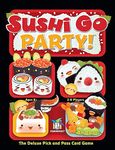
Sushi Go Party!
A cute party game where you pick 1 menu card at a time and pass the rest of your hand to your neighbor, drafting your way to the best sushi buffet. Unlike the base game, you choose which card types make up the menu every game, so the same game plays differently each time.
Rules
Play runs exactly like «Sushi Go!», but you build the menu yourself every game. You use only 8 of the 22 card types, so a different menu makes a very different game. A score track and pawns are in the box, so there is no paper to keep either.
What is the same as the original
The drafting structure — everyone picks 1 card at the same time, reveals together, and passes the rest of the hand to the left — and the 3 rounds are the same as in «Sushi Go!». This guide covers only what changed.
Components — 22 card types
| Component | Count |
|---|---|
| Cards | 181 |
| Menu tiles | 22 |
| Pawns | 8 |
| Game board | 1 (with the score track on it) |
| Category | Card types | Count |
|---|---|---|
| Nigiri | Nigiri (always used) | 12 |
| Rolls | 1 of maki roll · temaki · uramaki | 12 each |
| Appetizers | 3 of tempura · sashimi · dumpling · eel · tofu · onigiri · edamame · miso soup | 8 each |
| Specials | 2 of chopsticks · soy sauce · tea · menu · spoon · special order · takeout box · wasabi | 3 each |
| Desserts | 1 of pudding · green tea ice cream · fruit | 15 each |
The menu has 8 slots
1 nigiri + 1 roll + 3 appetizers + 2 specials + 1 dessert = 8 types, slotted into the game board as menu tiles. Only those 8 types appear in that game. Each tile has its scoring printed on it, so there is nothing to memorize.
What is different ② Setup and dealing out the desserts
- 1Put the game board in the middle. Each player picks a color and puts their pawn on space 0 of the board.
- 2Decide on the 8 card types for this game and put the matching menu tiles into the slots on the board.
- 3Put the chosen dessert cards aside in their own face-down pile next to the board.
- 4Shuffle all 7 other types together into a face-down deck and put it next to the board.
Only a set number of desserts is shuffled in each round
In the original, the puddings were in the deck from the start. Here you shuffle a set number of dessert cards into the deck before each round. Desserts therefore get scarcer as the game goes on.
| Round | 2-5 players | 6-8 players |
|---|---|---|
| Round 1 | 5 cards | 7 cards |
| Round 2 | 3 cards | 5 cards |
| Round 3 | 2 cards | 3 cards |
In a 2-5 player game the 5 leftover dessert cards are not used.
| Players | Cards dealt to each player |
|---|---|
| 2-3 players | 10 |
| 4-5 players | 9 |
| 6-7 players | 8 |
| 8 players | 7 |
What is different ③ The new cards
The exact scoring is printed on the menu tiles. Here we only describe what each card is like, which is what you need when putting a menu together.
| The 3 rolls | Character |
|---|---|
| Maki roll | The same as the original. Icons decide first and second place |
| Temaki | The most scores plus points, the fewest scores minus points. It swings both ways, like pudding |
| Uramaki | A race — you score by the order in which you reach 10 icons |
| Notable appetizers | Character |
|---|---|
| Eel | One card is minus points, two or more is a big plus. Half a gamble |
| Tofu | One or two score, three or more score 0. You have to know when to stop |
| Onigiri | The more different shapes you collect, the more it grows — squared |
| Edamame | Scores more for every opponent holding edamame |
| Miso soup | If anyone else plays a miso soup on the same turn, both are discarded |
| Notable specials | Character |
|---|---|
| Menu | Draw 4 cards from the deck, play 1, and return the rest |
| Spoon | Name a card and the first player to your left holding it gives it to you. The spoon goes into that player's hand |
| Special order | Copies another card you played on the same turn |
| Takeout box | Flips cards you already played so each is worth 2 points |
| Soy sauce | Scores if you have the most differently colored cards at the end of the round |
| Tea | Scores per card in your biggest set of a single color at the end of the round |
Rules people get wrong
Q. Do I need the original «Sushi Go!»?
No. This is a standalone game with many more cards. Pick the «Sushi Go!» menu and you get the original line-up.
Q. If I only buy one, which one?
Party is close to a superset. It plays 2-8, includes a score track, and offers many combinations. The box is bigger, though, and choosing a menu takes time. For travel or for playing with small children, the original is better.
Q. Do I have to build a new menu every game?
No, the suggested combinations in the rulebook work as they are. For your first few games we recommend «My First Meal» or «Sushi Go!».
Q. Why does the number of desserts change each round?
If the desserts piled up in the later rounds, the choices in the early rounds would not matter. The most go in for round 1 so the competition for desserts starts right away.
Q. Why are there two scoring tables for maki rolls?
In a 6-8 player game you flip the menu tile over and use the 6-8 player scoring, because more players mean more icons in total.
Q. Can the spoon ask for any card at all?
It has to be a card on that game's menu. The first player to your left holding it gives it to you, and the spoon goes into their hand.
History and editions
| Item | Detail |
|---|---|
| Designer | Phil Walker-Harding |
| Publisher | Gamewright, 2016 |
| Original | «Sushi Go!», 2013 |
| Players | 2-8 — the original was 2-5 |
Sources
Official Gamewright rulebook (Sushi Go Party!, English)Wiki cross-check — Wikipedia: Sushi Go!Rule summaries are reference content written by us, not quotations from the official rulebook. Always check the official rulebook for exact rules. Diagrams are original schematics, not rulebook illustrations.
Spotted a mistake? Tell us in the comments below →
Last updated 2026-09-14
💡 Master tip
When an opponent has picked up one tempura, taking the remaining tempura yourself so they never make the pair is the kind of draft blocking that matters.
Related games
Ready for something heavier
If this one has gotten too easy, try these — same feel, one step up in weight.
Tools you can request
Not built yet. Let us know if you want one — it goes on the list.
Sushi menu scoring calculator
Adds up tempura, dumpling and nigiri sets automatically
Dessert count tracker
Counts desserts across all 3 rounds
Comments
Share your thoughts, report a mistake, or request a tool. No sign-in needed — nicknames are not verified, so anyone can use the same one.
Loading…