Top 130
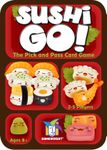
Sushi Go!
A drafting sushi card game where you keep 1 card from your hand and pass the rest along, the way you pick plates off the belt at a conveyor-belt sushi restaurant. The rules are simple and a game is over in 15 minutes, which has made it a widely loved party game for people new to board games.
Rules
A drafting game where you keep one card and pass the rest of your hand along. You play 3 rounds and score the puddings at the very end. Many cards only pay once a set is complete, so what you hand on is where the game is really decided.
Components — 108 cards
| Card | Count | How it scores |
|---|---|---|
| Tempura | 14 | 5 points per set of 2. A single card scores nothing |
| Sashimi | 14 | 10 points per set of 3. One or two cards score nothing |
| Dumpling | 14 | The more you collect, the better (1 · 3 · 6 · 10 · 15 points) |
| Maki roll | 26 | 12 cards with 2 icons · 8 with 3 icons · 6 with 1 icon |
| Salmon nigiri | 10 | 2 points |
| Squid nigiri | 5 | 3 points |
| Egg nigiri | 5 | 1 point |
| Wasabi | 6 | Triples the value of the next nigiri you play |
| Chopsticks | 4 | Take 2 cards on a later turn |
| Pudding | 10 | Scored at the end of the game |
Setup
| Players | Cards dealt to each player |
|---|---|
| 2 players | 10 |
| 3 players | 9 |
| 4 players | 8 |
| 5 players | 7 |
- Shuffle the cards well and deal a hand to each player. Keep your hand secret from the others.
- Put the rest of the cards in a face-down pile in the middle of the table.
- Get a piece of paper and a pencil, and pick one player to keep score.
Playing a turn — pick, reveal, pass
- 1Everyone at the same time picks 1 card from their hand and places it face-down in front of them.
- 2Once everyone has placed a card, reveal them all together.
- 3Pass the rest of your hand face-down to the player on your left.
- 4Pick up the hand passed to you and start the next turn. Hands get one card smaller each turn.
Group cards of the same type together. Scoring goes much faster, and you can see at a glance what everyone else is collecting.
Wasabi and chopsticks
The wasabi has to come first
If a wasabi is already in front of you and you then play a nigiri (squid, salmon, or egg), that nigiri must go on top of the wasabi and is worth triple. A wasabi taken later does nothing for a nigiri you already played.
| Nigiri | On its own | On a wasabi |
|---|---|---|
| Squid nigiri | 3 points | 9 points |
| Salmon nigiri | 2 points | 6 points |
| Egg nigiri | 1 point | 3 points |
- You may have several wasabi cards, but only one nigiri goes on each wasabi.
- A wasabi with no nigiri on it scores nothing.
- Chopsticks must already be in front of you to be used. To use them, pick your card as usual and then, before everyone reveals, call out "Sushi Go!" and place a second card from your hand face-down as well.
- When you use the chopsticks, put the chopsticks card back into your hand and pass it on. The next player can use it again.
- You may have several chopsticks cards in front of you, but only one per turn may be used.
- Chopsticks themselves score nothing.
Scoring a round
When the last card of each hand is passed on, simply place it face-up and the round ends. That final card is usually useless, but with bad luck you hand someone else something valuable.
| Card | Points |
|---|---|
| Tempura | 5 points per set of 2. Several sets are fine. A leftover single card scores nothing |
| Sashimi | 10 points per set of 3. One or two cards score nothing |
| Dumpling | 1 for one · 3 for two · 6 for three · 10 for four · 15 for five or more |
| Squid / salmon / egg nigiri | 3 / 2 / 1 points (tripled on a wasabi) |
| Wasabi (with no nigiri) | 0 points |
| Chopsticks | 0 points |
Maki rolls: 6 points for the most, 3 for second
You compare the number of maki icons printed at the top of the cards, not the number of cards. The most icons scores 6 points and the second most scores 3 points.
- Tied players split the points evenly and ignore the remainder. Two players splitting 3 points get 1 point each.
- If players tie for the most, they split the 6 points and nobody gets the 3 points for second place.
- 1Announce your score to the scorekeeper.
- 2Discard the cards you used face-up beside the draw pile. The one exception is pudding, which stays in front of you.
- 3Deal everyone a new hand of the same size as the last round and start the next round.
Ending the game — scoring the puddings
Once the third round is scored, ignore whatever is left in the draw pile. Now it is time for dessert: the puddings.
- The player with the most puddings scores +6 points. Tied players split them (ignoring the remainder).
- The player with the fewest puddings loses 6 points. Players with none are included. Tied players split the lost points.
- If everyone has the same number, nobody gains or loses anything.
- In a 2 player game there is no −6. Only the +6 for the most puddings is awarded.
- The highest total wins. On a tie, whoever has more puddings wins.
Losing 6 points for puddings wipes out a whole round of scoring. Take no pudding at all across the 3 rounds and you will almost certainly collect the penalty for the fewest.
Official variants
- Pass both ways — pass to the left in rounds 1 and 3 and to the right in round 2. Who sits next to whom matters differently each round.
- Two-player variant — deal three players' worth of cards (3 hands of 9) and put the third hand face-down between you as a dummy pile. Whoever controls the dummy draws its top card into their hand, then picks 1 card for themselves and 1 for the dummy. After revealing, swap hands, and your opponent controls the dummy next.
Rules people get wrong
Q. If I take a wasabi the turn after a nigiri, does the nigiri triple?
No. The wasabi has to be in front of you first, and only a nigiri played after it goes on top.
Q. Can I put a nigiri somewhere else while I have an empty wasabi?
No. If an empty wasabi is there, the nigiri must go on it. Tripling is never a loss, so it never hurts you.
Q. Can I use chopsticks the turn I take them?
No. You can use them from the following turn, once they are in front of you.
Q. Are the chopsticks discarded when used?
No. They go back into your hand and get passed on, which is why one chopsticks card is used several times in a round.
Q. Are maki rolls compared by number of cards?
No. You compare the total number of icons printed on them. One card with 3 icons beats two cards with 1 icon each.
Q. How much are 3 tempura worth?
5 points. Only one set of 2 is complete and the leftover card scores nothing. Four cards score 10.
Q. Are puddings discarded at the end of each round?
No. Puddings alone stay in front of you across all 3 rounds and are scored once, at the end of the game.
Q. What happens to the remainder when splitting points?
It is ignored. Two players splitting 3 points get 1 point each and the leftover point disappears.
History and editions
| Item | Detail |
|---|---|
| Designer | Phil Walker-Harding |
| Illustrations | Nan Rangsima |
| Publisher | Gamewright, 2013 |
| Two-player variant by | Peter Kinsley |
| Follow-up | Released | Notes |
|---|---|---|
| Sushi Go Party! | 2016 | A standalone game where you build the menu from a pool of card types. 2-8 players |
| Sushi Roll | 2019 | A spin-off played with dice instead of cards |
«Sushi Go Party!» is close to a superset of the base game. Its card mix changes every game, though, so the scoring table in this guide does not carry over unchanged.
Sources
Official Gamewright rulebook (Sushi Go!, English)Wiki cross-check — Wikipedia: Sushi Go!Rule summaries are reference content written by us, not quotations from the official rulebook. Always check the official rulebook for exact rules. Diagrams are original schematics, not rulebook illustrations.
Spotted a mistake? Tell us in the comments below →
Last updated 2026-09-14
💡 Master tip
The hands coming around to you show what the others are collecting. Cutting off a Sashimi set or the Maki rolls in the hand you pass on decides games just as much as building your own score does.
Related games
Ready for something heavier
If this one has gotten too easy, try these — same feel, one step up in weight.
Tools you can request
Not built yet. Let us know if you want one — it goes on the list.
Automatic scoring by round
Enter how many of each card type you have and it works out the Maki roll contest and the set scores
Final Pudding scoring
Applies the most-and-fewest Pudding adjustment automatically at the end of round 3
Comments
Share your thoughts, report a mistake, or request a tool. No sign-in needed — nicknames are not verified, so anyone can use the same one.
Loading…