Top 37 · #7 of 19 in Co-op
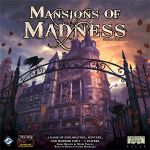
Mansions of Madness: Second Edition
A dedicated smartphone/PC app plays the hidden Game Master, leading you through a mansion and a haunted town's mysteries in this cooperative Cthulhu Mythos adventure. Managing both Health and Sanity creates a double layer of pressure that keeps the tension high.
Rules
A companion app plays the hidden Keeper, generating the map, monsters, and events on the fly in this fully cooperative Cthulhu investigation game. Investigators must manage both Health and Sanity, and running out of either leaves them Wounded or Insane.
Components and the Official App
| Component | Count | Note |
|---|---|---|
| Investigator cards & figures | 8 | Each has Health, Sanity, and 6 skills |
| Map tiles | 24 | The app combines and places them differently every scenario |
| Monster tokens & figures | 24 | Awareness, Horror Rating, and Brawn are printed on the token |
| Common and Unique Item cards | 40 + 24 | Weapons have a melee or ranged icon and a damage value |
| Spell cards | 30 | Double-sided; flip to the back's effect when cast |
| Condition cards | 37 | Includes Insane Conditions; double-sided |
| Damage and Horror cards | 40 each | Resolve Immediately or Keep Faceup types |
| Search/Interact and Explore/Sight tokens | 16 each | Two sides of the same token |
| Person tokens | 22 | Anonymous silhouettes and full-color unique characters |
| Barricade, Fire/Darkness, Secret Passage tokens | 4 + 18 + 4 | Terrain effects — resolved by rule, no app needed |
| Clue tokens | 26 (unlimited substitutes if they run out) | Spent to convert dice results or gain extra puzzle steps |
| Dice | 5 (eight-sided) | 3 success faces · 2 investigation faces · 3 blank faces |
| First-edition conversion kit | Included separately | Brings 1st-edition investigators, monsters, and map tiles into 2nd edition |
You cannot play without the app
Per the publisher's own FAQ, the companion app takes over the entire Keeper role. It generates the map, monsters, and events on the fly, so you must install the official app on a PC, Mac, iOS, or Android device before starting.
Setup
- 1Shuffle the Damage and Horror decks separately and place them facedown, then spread the Common Item, Unique Item, Spell, and Condition decks faceup in alphabetical order.
- 2Sort the map tiles by size, and slot each monster token into its matching figure base.
- 3Group the remaining tokens by type.
- 4Launch the app and select 'New Game,' then choose a scenario together. For a first game, 'Cycle of Eternity' is recommended for its shorter, simpler setup.
- 5Each player picks one investigator card and figure. In solo play, that player controls two investigators.
- 6Following the app's instructions, distribute the starting items, spells, or other possessions among the investigators.
- 7Read the scenario's prologue aloud, then place the starting map tile(s), investigator figures, and any features, Search tokens, and Explore tokens exactly as the app instructs.
The true objective stays hidden
The scenario's real win condition is not revealed at the start. You piece it together from the prologue and the clues you uncover, and once the investigation has progressed enough, the app reveals the final task.
The Round — Investigator Phase and Mythos Phase
During the investigator phase, players take turns in whatever order they choose. On your turn, you take 2 actions, and you may repeat the same action twice.
| Action | What it does |
|---|---|
| Move | Up to 2 adjacent spaces. Leaving a monster's space first requires an evade check |
| Explore | Investigate an Explore token in an adjacent room via the app — new map tiles and tokens appear |
| Search | Investigate a Search token in your space via the app — usually includes a skill test |
| Interact | Investigate a Person or Interact token in your space via the app — choices may branch |
| Trade | Give or take possessions with another investigator in your space, or pick up/drop possessions in your space |
| Attack | Attack a monster with a melee or ranged item or spell — the app resolves the damage |
You must evade before leaving a monster's space
To take any action other than attack or move, or to voluntarily leave a monster's space, you must first evade that monster. Failing the evade check can cost you the action entirely (the app will tell you). If multiple monsters share your space, you only need to evade the one with the highest Awareness.
The mythos phase always runs Event → Monster activation → Horror check, all directed by the app. Monsters move toward and attack the nearest investigator, and each investigator resolves a horror check against only the single monster within range (3 spaces) with the highest Horror Rating.
Skill Tests
Investigators have 6 skills — strength, agility, observation, lore, influence, and will — each rated from 2 to 5. When app text embeds a skill icon in parentheses, that is the skill you must test.
- 1Roll a number of dice equal to the tested skill's value (minimum 1).
- 2The dice are 8-sided, with 3 success faces, 2 investigation faces, and 3 blank faces.
- 3You may discard any number of Clues to convert that many investigation results into success results.
- 4If the final success count meets or exceeds the required difficulty, you pass; otherwise you fail. An unstated difficulty is usually 1.
Puzzles spend the same resource
Slide, code, and lock puzzles give you a number of puzzle steps equal to the indicated skill's value, and spending a Clue grants one more step. No dice are rolled, but the resource economy is the same as a skill test.
Damage, Horror, and the Wounded/Insane Conditions
Health and Sanity are fixed values printed on your investigator card; suffering Damage or Horror never reduces them directly. Instead, your status changes once the number of Damage or Horror cards you hold reaches that value.
| Status | Condition | Effect |
|---|---|---|
| Wounded | Damage suffered (faceup + facedown) ≥ Health | Discard all facedown Damage; cannot perform the move action more than once per round |
| Insane | Horror suffered ≥ Sanity | Discard all facedown Horror and gain 1 hidden Insane Condition — it can personally change how you win or lose |
| Eliminated | Already Wounded or Insane, and that same resource hits its limit again | Drop your possessions and leave the board. Remaining investigators get only one more investigator phase |
Losing every investigator loses the game on the spot
If every investigator is eliminated, the game is lost immediately. If at least one remains, the survivors get one more full investigator phase; if the investigation still isn't complete after that phase, they lose.
Reading a Monster Token
A monster token's front shows its Health and Awareness (used for evade checks); its back shows Horror Rating (used for horror checks) and Brawn (used when it tries to break through a barricade).
| Stat | Where it's used |
|---|---|
| Awareness | Decides which monster must be evaded when multiple share a space — the highest one |
| Horror Rating | Decides which monster a horror check targets when several are within range — the highest one |
| Brawn | The number of dice rolled when a monster tries to move through a barricaded door |
A melee item or spell can only attack a monster in your own space; a ranged item or spell can attack any monster within range (3 spaces). Once a monster's accumulated damage reaches its Health, it is defeated immediately.
Investigators
The core box includes 8 investigators, each combining Health, Sanity, and the 6 skills (strength, agility, observation, lore, influence, will) differently. Higher Health usually pairs with lower Sanity, and vice versa.
| Investigator | Confirmed trait |
|---|---|
| Rita Young | An athletic, willful investigator — Health 9, best able to shrug off physical damage (confirmed by the official announcement article) |
| Wendy Adams | Health 6, physically fragile but keen-eyed and comparatively steady of mind (confirmed by the official announcement article) |
| Agatha Crane | A parapsychologist — exact values require checking the physical card |
| Carson Sinclair | The example character who fights with a Crowbar (melee weapon) — exact values require checking the physical card |
| Preston Fairmont | A businessman-type character who appears in a scenario's prologue — exact values require checking the physical card |
The other 3 are not listed here
The core box has 8 investigators, but only the 5 above could be confirmed by name and trait from the official rulebook and announcement article. The remaining 3 are only confirmable from the physical cards, so this guide does not guess at them.
Winning and Losing
| Outcome | Condition |
|---|---|
| Win | Complete the hidden final objective — once the investigation has progressed enough, the app reveals the last task |
| Lose — ran out of time | Taking too long before completing the objective makes it harder, and can ultimately end in a failure epilogue |
| Lose — wiped out | Every investigator is eliminated |
Some Insane Conditions change how that individual investigator wins or loses. For example, a specific condition might let that investigator win alone, or make them lose even if everyone else wins — such effects are stated directly on the card.
Playing Tips
- Assign a high-Health investigator (like Rita Young) to confront monsters directly, and a high-Sanity investigator to the exploring roles that trigger frequent horror checks — damage spreads out more evenly this way.
- Clues are your only way to turn a failed test into a pass. Saving them for a decisive test is often better than spending them early.
- Rather than fighting every monster head-on, simply evading past one with low Awareness is often the safer play.
- Horror checks in the mythos phase only trigger within 3 spaces. Staying farther than that from a monster removes its horror checks entirely.
Expansions and the Korean Edition
| Material | Detail |
|---|---|
| First-edition conversion kit | Included in the core box — brings 16+ first-edition investigators, monsters, and map tiles into the app for 2nd edition |
| Beyond the Threshold (2016) | The first 2nd-edition expansion |
| Streets of Arkham (2017) | An expansion set around the streets of Arkham |
| Sanctum of Twilight (2018) | Expansion |
| Horrific Journeys (2019) | Officially localized into Korean |
| Path of the Serpent (2019) | Officially localized into Korean |
Korea Boardgames officially publishes a Korean edition
A Namuwiki cross-check indicates Korea Boardgames released a Korean edition (with a Korean-language app) on August 1, 2019, and later localized the Horrific Journeys and Path of the Serpent expansions, with Korean voice dubbing added from 2021. This guide could not obtain the Korean rulebook text directly, though, so it stays at the `rulebook` grade (English edition only).
Rules People Get Wrong
Q. Can I play from the rulebook alone, without the app?
No. As the publisher's own FAQ confirms, the app generates the map, monsters, and events and plays the entire Keeper role, so the game cannot be played without it.
Q. Do suffering Damage or Horror actually reduce Health or Sanity?
No. Health and Sanity are fixed. Instead, becoming Wounded or Insane depends on the number of Damage or Horror cards you are holding reaching that value.
Q. If multiple monsters share a space, can I evade whichever one I like?
No. You only need to evade the single monster in that space with the highest Awareness.
Q. Can a ranged weapon only attack a monster in my own space too?
No. Items or spells with the ranged icon can attack any monster within range (3 spaces). Only melee attacks are limited to your own space.
Q. Can Clues be used for anything besides skill tests?
Yes. You can also discard Clues while attempting a puzzle to gain extra puzzle steps.
Q. Does the game end the instant one investigator is eliminated?
No. The remaining investigators get one more investigator phase. Only if the investigation still isn't complete by the end of that phase do they lose. Losing every investigator at once ends the game immediately.
History and Editions
| Item | Detail |
|---|---|
| First-edition design | Corey Konieczka, 2011, Fantasy Flight Games |
| First-edition expansions | Forbidden Alchemy (2011), Call of the Wild (2013) |
| Second-edition design | Nikki Valens, released August 4, 2016 |
| Second-edition's core change | A companion app takes over the Keeper role, enabling fully cooperative and solo play |
| Second-edition expansions | Beyond the Threshold → Streets of Arkham → Sanctum of Twilight → Horrific Journeys → Path of the Serpent |
According to English Wikipedia, the first edition won the 2011 Golden Geek Best Thematic Board Game award. The game shares its setting with Arkham Horror, Elder Sign, and Eldritch Horror, a connection the second-edition announcement article makes explicit as well.
Sources
Official Fantasy Flight Games Learn to Play (English, 2016, 20 pages)Official Fantasy Flight Games Rules Reference (English, 2016, 24 pages)Official Fantasy Flight Games Second Edition announcement article (2016-07-25, includes sample investigators and the app-required FAQ)Wiki cross-check — Wikipedia: Mansions of MadnessWiki cross-check — Namuwiki: Mansions of Madness Second Edition (confirms the Korean release)Rule summaries are reference content written by us, not quotations from the official rulebook. Always check the official rulebook for exact rules. Diagrams are original schematics, not rulebook illustrations.
Spotted a mistake? Tell us in the comments below →
Last updated 2026-10-11
💡 Master tip
Ignoring the magnifying-glass markers and evidence clues on the map leaves too little time to resolve the case before the mythos phase floods the board with monsters. Characters with low Sanity are safer kept on investigation and support duty rather than thrown into reckless combat.
Similar games
Ready for something heavier
If this one has gotten too easy, try these — same feel, one step up in weight.
Tools you can request
Not built yet. Let us know if you want one — it goes on the list.
Official mobile companion app integration
Sound effects, map placement, and monster AI control
Investigator status and condition card manager
See Wounded/Insane status at a glance
Comments
Share your thoughts, report a mistake, or request a tool. No sign-in needed — nicknames are not verified, so anyone can use the same one.
Loading…