Top 131 · #24 of 32 in Party
JinxO (Dito!)
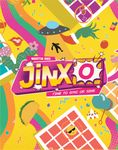
A word-association party game that rewards sharp social instincts — you must come up with answers that aren't too different, but also not too identical. Designed by Indonesian designer Martin Ang, it was originally titled 'Dito!' and is known internationally as 'JinxO'; it won the 2026 Spiel des Jahres (Game of the Year) award. The core of the game isn't landing a single 'correct' answer, but the psychological tug-of-war over exactly how many other people end up matching you.
Rules
Secretly write three answers to a prompt, then reveal them one at a time to see who else matched. No match scores nothing; matching exactly one other player scores the most in this party guessing game.
Components and objective
| Component | Count | Notes |
|---|---|---|
| Category cards | 200 | Each card shows two different prompts; the active player picks one to read aloud |
| Player boards | 7 | A 3×3 grid of answer cells plus row/column bonus numbers and a 3-round score track |
| Wipeable markers | 7 | Write your answers, then wipe the board clean after each round |
For 3–7 players aged 10 and up; the box states a minimum of 30 minutes with no printed upper bound. Write answers that fit the prompt while aiming for the sweet spot of matching exactly one other player — not so obvious that everyone matches, not so odd that no one does.
Setup
- 1Shuffle all 200 category cards (or a smaller subset for a shorter game) face down into a draw pile in the middle.
- 2Each player takes a player board and a wipeable marker.
- 3The game runs for 3 rounds. Each round has two phases: choosing prompts and writing answers, then revealing them.
Round structure
- 1A random player starts (from round 2 on, the player with the fewest points), then play passes clockwise, each drawing the top category card in turn.
- 2The drawing player picks one of the card's two prompts and reads it aloud.
- 3Everyone secretly thinks of three answers fitting that prompt and writes them into any empty cells of their own choosing on their board.
- 4Repeat this cycle (draw a card → pick one prompt → write 3 answers) three times per round until all nine cells are filled, then move to the reveal phase together.
Keep your board hidden while writing
While writing, make sure no one else can see your cells. Nothing is shown to anyone until the reveal phase begins.
Rules for writing answers
- An answer may be at most two words, except for fixed phrases, idioms, or proper names treated as a single unit (e.g. “The Lord of the Rings”).
- You may not write the same answer twice within one round, even if it would also fit a different prompt you already answered.
- You may choose freely which of the nine cells to put each answer in — anticipating which row or column you might complete later is part of the strategy.
Reveal and scoring a match
Once all nine cells are filled, the youngest player (from round 2 on, whoever has the fewest points so far) reveals first, then play passes clockwise. The active player picks one of their own not-yet-judged answers and reads it aloud. An answer already called out this round cannot be read again.
- 1If no one else wrote the same answer, cross it out with an × (0 points).
- 2If exactly one other player wrote the same answer, both players shout together (the German edition uses “SAME!”, “DITO!”, or “EBENSO!” — any of the three) and both circle that cell and colour in the star (BFF star).
- 3If two or more other players wrote the same answer, everyone involved shouts together and circles the cell only — no star.
- 4Play continues clockwise this way until someone has no more answers left to judge (all circled or crossed); that player calls it, ending the round immediately for everyone. Any answers not yet revealed by others simply stay unresolved.
Scoring a round
| Item | Points |
|---|---|
| Each circled answer | 1 point |
| Each star (BFF star) | 2 points (1 point each in a 3-player game) |
| Each crossed-out answer | 0 points |
| A full row of 3 circles | that row's printed bonus — 3, 2, 1 from top to bottom |
| A full column of 3 circles | that column's printed bonus — 1, 2, 3 from left to right |
Write that total into the round's score cell, then wipe the board clean for the next round (keeping only the round totals recorded beside it).
Game end and winning
- 1After 3 rounds, add up each player's three round scores into the total score cell.
- 2The highest total wins.
- 3If tied, whoever among the tied players had the higher single-round score wins.
- 4If still tied, those players share the win.
Strategy tips
- A too-obvious answer gets circled only (1 point) when several others match it; a too-unusual one gets crossed out (0 points) when no one matches. Aim for answers you think exactly one other player will share.
- Since you choose freely where each answer goes among the nine cells, clustering answers into one row or column lets you collect its bonus if the whole line ends up circled.
- Avoiding answers already called out by others is part of the game — listening to what has already been revealed tells you something about what is likely to happen to your own remaining answers.
Editions and variants
The German rulebook explicitly allows using “all 200 category cards, or only part of them” as the draw pile — an official way to shorten the game by using fewer cards. No other expansion or separate edition was confirmed in this research.
Frequently asked questions
Q. What counts as 'the same answer' when it's ambiguous?
The German rulebook notes that answers are usually not considered the same if one is more specific or more general than the other (e.g. 'instrument' vs. 'violin' differ), but synonyms or different phrasings of the same thing do count as the same (e.g. 'violin' vs. 'fiddle' match). If players still disagree, settle it as a group on the spot.
Q. Does an answer have to be a single word?
No. Up to two words is fine. A fixed name or idiom like 'The Lord of the Rings' is allowed as an exception even if it's longer.
Q. Do I get the star if several people match my answer?
No. The star is only awarded when exactly one other player matches. Two or more matches still circle the cell, but no star.
Q. Does scoring change with 3 players?
Yes — each star is worth 1 point instead of 2. Circles, crosses, and row/column bonuses work the same regardless of player count.
Q. What happens to my unrevealed answers if someone else ends the round first?
The round ends immediately, so any of your answers not yet read aloud stay unresolved — neither circled nor crossed — which effectively scores them as 0.
Q. Is there an officially released Korean edition?
Not confirmed in this research. As this is freshly announced as the 2026 Spiel des Jahres winner, whether a Korean release exists at all is ⚠️ unverified.
Designer and awards
Originally titled Dito! (international title JinxO), the game was designed by Indonesian designer Martin Ang and released in its 2026 edition by Swiss publisher Game Factory under license from Indonesia's Tabletoys Games (German/Swiss distribution via Carletto). Illustration is by UNTAI Studio.
Cross-checking the official Spiel des Jahres site against the English Wikipedia winners list confirms Dito! (JinxO) as the 2026 Spiel des Jahres (Game of the Year) winner. That same year, the Connoisseur-gamer category went to Rebirth (Reiner Knizia) and the Children's Game category to Die Insel der Mookies (Mooki Island).
Sources
Official German rulebook PDF (Game Factory, 2026 edition, all 4 pages checked)Game Factory official product page — DitoSpiel des Jahres official site — 2026 winner announcement (Dito!/JinxO, Martin Ang, Game Factory)Wikipedia cross-check — confirmed the 2026 entry in the Spiel des Jahres winners listRule summaries are reference content written by us, not quotations from the official rulebook. Always check the official rulebook for exact rules. Diagrams are original schematics, not rulebook illustrations.
Spotted a mistake? Tell us in the comments below →
Last updated 2026-10-10
💡 Master tip
An answer that's too obvious ends up matching too many people and becomes muddled, while one that's too unusual matches no one at all — so the key skill is aiming for an answer that feels like it will click with 'exactly one' other player. Reading your opponents (whether they're close friends or people you just met) sharpens your predictions.
Ready for something heavier
If this one has gotten too easy, try these — same feel, one step up in weight.
Tools you can request
Not built yet. Let us know if you want one — it goes on the list.
Draw a Prompt Card
Presents a random prompt
Comments
Share your thoughts, report a mistake, or request a tool. No sign-in needed — nicknames are not verified, so anyone can use the same one.
Loading…